

What are the best Airtasker alternatives for Sydney homeowners renovating in 2026?
For Sydney homeowners planning a renovation, Airtasker alternatives worth knowing fall into two distinct categories: general tradie-matching platforms and purpose-built approval navigation tools. If your project involves a granny flat, garage conversion, or any structural change, the second category is where you need to focus.
| Platform | Service Type | Local Council Support | Pricing | Usability for Sydney Homeowners | Additional Features |
|---|---|---|---|---|---|
| Navilot | Approvals navigation | Comprehensive Sydney council coverage | Free start; $49 detailed roadmap | Guided questionnaire, tailored checklists | Document workspace, professional connections |
| Airtasker | Tradie matching (DIY) | None | Free to post; service fees apply | Simple task posting | Reviews, messaging |
| hipages | Tradie matching | None | Free to post; lead fees for tradies | Quote comparison | Verified reviews, licence checks |
| ServiceSeeking | Tradie matching | None | Free to post; subscription for tradies | Quote comparison | Ratings, project photos |
| Houzz | Design + contractor discovery | None | Free browsing; paid for pros | Inspiration-led | Portfolio browsing, idea books |
Key standout benefits at a glance:
- Navilot: Identifies your DA, CDC, or exempt pathway before you spend a dollar on plans; organizes every document you need in one workspace.
- Airtasker: Fast for small, straightforward tasks; no approval guidance whatsoever.
- hipages: Good for comparing licensed tradies; no help with council requirements.
- ServiceSeeking: Broad contractor pool; purely transactional, no regulatory support.
- Houzz: Strong for design inspiration; not built for Sydney's approval process.
Table of Contents
- How do Navilot and other platforms compare on features that matter?
- How do you choose the right renovation approval platform for your project?
- What approval challenges do Sydney homeowners actually face?
- Detailed look at Airtasker alternatives for Sydney renovation approvals
- What real project outcomes look like with approval-focused platforms
- Key Takeaways
- Navilot gives Sydney homeowners a clear path before the first brick moves
How do Navilot and other platforms compare on features that matter?
The gap between Navilot and tradie-matching platforms becomes obvious the moment a project touches council approval. Platforms like Airtasker, hipages, and ServiceSeeking connect you with workers. They do not tell you whether your project needs a Development Application (DA), a Complying Development Certificate (CDC), or qualifies as exempt development. That distinction matters enormously in practice, because confirming the specific approval pathway before demolition begins is what keeps a project legal, especially in heritage or bushfire-prone areas.

Navilot's core differentiator is its guided property questionnaire, which maps your specific project to the likely approval pathway and generates a custom checklist of required documents. The $49 detailed roadmap is a one-time fee, not a subscription. Competing platforms charge nothing upfront but offer nothing on the approvals side either.
Pros and cons summary:
- Navilot: Purpose-built for Sydney approvals; transparent one-time pricing; document workspace included. Limited to preparation and navigation, not legal advice.
- Airtasker/hipages/ServiceSeeking: Wide contractor pools; easy to post jobs. Zero council guidance; quality varies significantly by tradie.
- Houzz: Rich design content. Not a functional tool for approval preparation.
Engaging design and planning experts early to clarify DA versus CDC pathways is consistently recommended by renovation professionals, and Navilot's platform is built around exactly that principle.
How do you choose the right renovation approval platform for your project?
Match the tool to what you actually need. A platform like Airtasker is fine for booking a painter. It is not the right tool when your project requires council sign-off.
Criteria to evaluate any platform:
- Project scope: Does the platform address your specific work type (structural, granny flat, garage conversion)?
- Council coverage: Does it cover your Sydney local government area?
- Pricing transparency: Is the cost clear before you commit?
- Ease of use: Can you get meaningful guidance without calling anyone?
- Timing: Can you engage the platform before lodging any applications?
Best practices for vetting platforms:
- Check whether the platform distinguishes between DA, CDC, and exempt pathways for your property type.
- Confirm the DA lodgement checklist requirements for your council before choosing a platform that claims to cover them.
- Ask whether the platform connects you to accredited certifiers or planners, not just general tradies.
- Read what past users say about council-specific guidance, not just general satisfaction.
Pro Tip: Engage an approval navigation platform before you finalize your design. Changes made after a DA is lodged cost far more than changes made during preparation.
Timing is a real factor. Starting construction without signed contracts and confirmed approval documents causes budget blowouts and delays. The right platform gets you organized before any of that begins.
What approval challenges do Sydney homeowners actually face?
Sydney's approval system is genuinely complex. Three pathways exist: DA (Development Application), CDC (Complying Development Certificate), and exempt development. Which one applies to your project depends on zoning, heritage overlays, lot size, proposed height, and setbacks. Getting this wrong is expensive.
Heritage listings and bushfire-prone zones add another layer. A project that would qualify as complying development in one suburb may require a full DA in the next street. Renovation specialists note that projects in occupied homes require careful trade sequencing and often reveal surprises behind walls, which can significantly increase costs compared to new builds. Homeowners also need to verify each builder's licence class matches the actual scope of work, since a tiler's licence does not cover structural or plumbing tasks. Public liability insurance certificates should show coverage of $10m–$20m for residential building work.
Detailed look at Airtasker alternatives for Sydney renovation approvals
Navilot is the only platform in this comparison built specifically for the approval preparation stage. It asks property-specific questions, identifies your likely pathway, and produces a document checklist tailored to your council. The free tier gives you a project check; the $49 roadmap delivers the full, actionable plan.
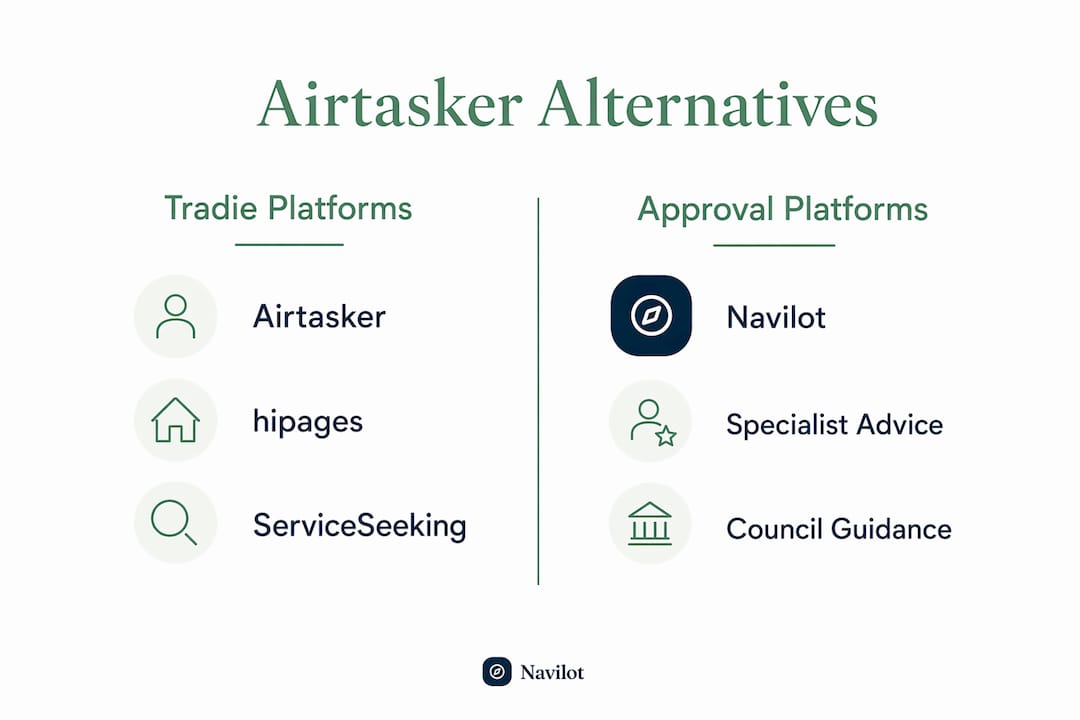
Airtasker works well for discrete, low-complexity tasks: moving furniture, minor repairs, cleaning. For anything touching council approval, it offers no guidance. Experts recommend collecting at least three detailed, itemized quotes for major renovations, and Airtasker's quote process is not structured for that level of comparison.
hipages does verify licences and insurance, which matters. But its scope ends at connecting you with a tradie. The approval pathway question remains entirely yours to answer.
ServiceSeeking and Houzz follow the same pattern: useful for finding contractors or design ideas, silent on the regulatory side.
For a Sydney homeowner whose project needs council approval, none of the tradie-matching platforms substitute for a tool that actually addresses the approval process.
What real project outcomes look like with approval-focused platforms
Without fabricated testimonials to draw on, the honest picture comes from what goes wrong without proper preparation. Projects that skip the approval identification step routinely stall at the DA lodgement stage because documents are incomplete. Word-of-mouth referrals from neighbours remain the most reliable way to find tradies, but they do not solve the approval documentation problem. A platform that organizes your documents and maps your pathway before you engage any contractor removes the most common source of delay.
Key Takeaways
Navilot is the only platform among these Airtasker alternatives that addresses Sydney renovation approvals directly, making it the practical first step for any homeowner whose project needs council sign-off.
| Point | Details |
|---|---|
| Approval pathway first | Identify DA, CDC, or exempt status before engaging any contractor or platform. |
| Platform type matters | Tradie-matching apps (Airtasker, hipages) offer no council guidance; use them only after approvals are clear. |
| Renovation cost premium | Occupied-home renovations cost significantly more per square metre than new builds; budget accordingly. |
| Insurance verification | Confirm public liability coverage of $10m–$20m before any builder starts work. |
| Navilot's role | Navilot provides a free project check and a $49 detailed roadmap covering Sydney council requirements and document preparation. |
Navilot gives Sydney homeowners a clear path before the first brick moves
Every platform listed here has a use. Airtasker finds you a handyman. hipages connects you with a licensed builder. Neither one tells you whether your granny flat needs a DA or qualifies for CDC, which documents your council requires, or what heritage overlays affect your block.
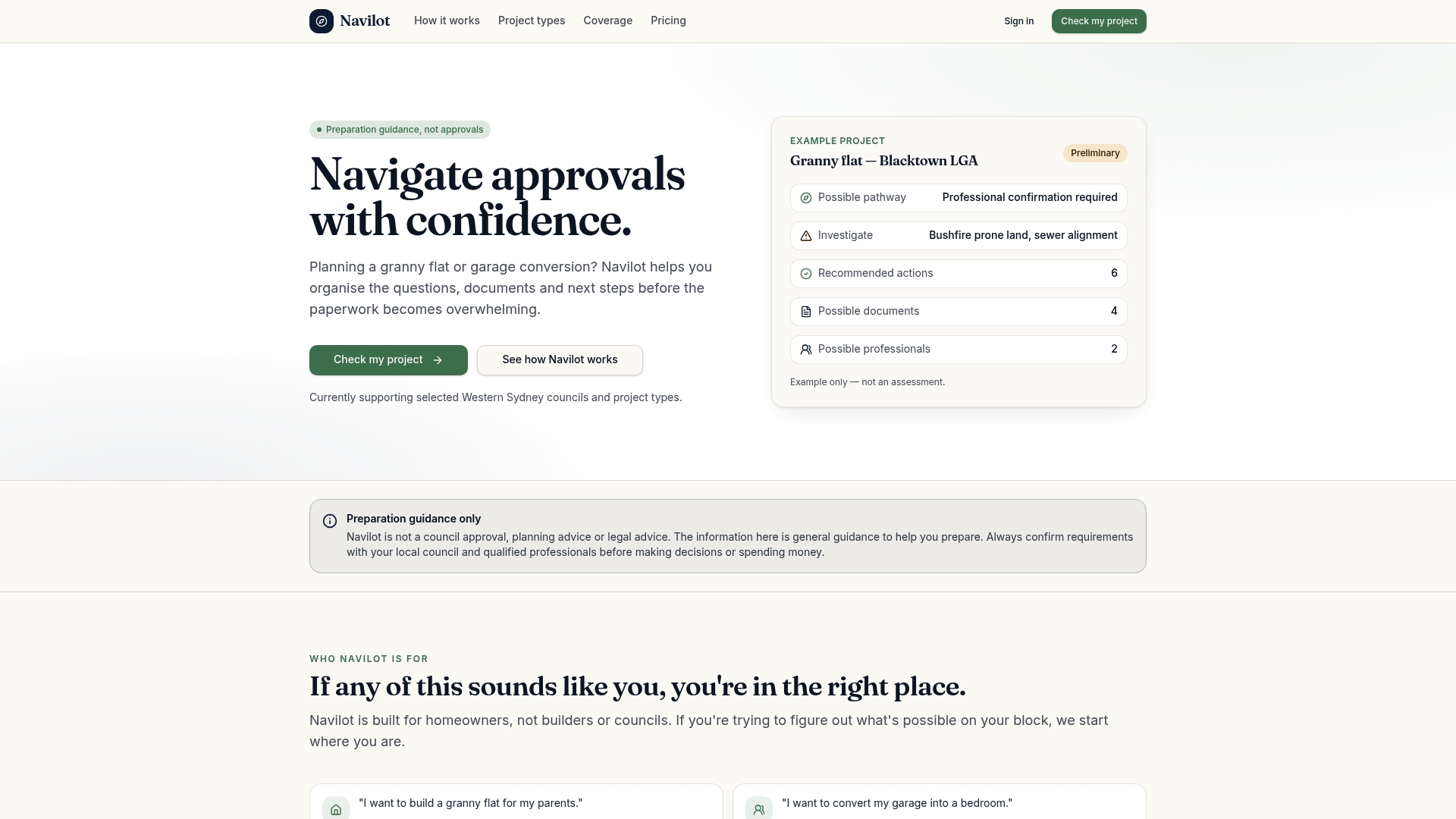
Navilot fills that gap. The free project check takes minutes and tells you where your project stands. The $49 detailed roadmap gives you a council-specific document checklist, an approval pathway summary, and a workspace to organize everything before you talk to a single tradie. No subscription, no ongoing fees. For homeowners who want clarity before committing to plans or contractors, see how Navilot works and check what your project roadmap includes.