
What is complying development in NSW and how does it work?
Complying development is a combined planning and construction approval for straightforward residential, commercial, and industrial projects. Instead of lodging a traditional Development Application and waiting months for a council decision, you get a single Complying Development Certificate (CDC) issued by either your local council or an accredited private certifier.
The key distinction: CDC is a checklist process, not a judgment call. If your project meets every standard in the Codes SEPP, approval cannot be refused on merit. That certainty is what makes it attractive for homeowners tackling straightforward builds or renovations.
Key features of the CDC pathway:
- Fast approval: as little as 20 days, or 10 days under the NSW Housing Pattern Book pathway
- Single certificate: combines planning and construction approval in one document
- Two assessment options: local council or a registered private certifier
- Preset standards: governed by the Codes SEPP, not subjective council discretion
- Broad scope: applies to homes, businesses, and industrial projects
- Conditions apply: the CDC comes with conditions protecting surrounding uses during construction
What legislation and codes govern complying development?
The primary document is the State Environmental Planning Policy (Exempt and Complying Development Codes) 2008, universally referred to as the Codes SEPP. It sets the baseline development standards for every eligible project type across NSW.
Local Environmental Plans (LEPs) and Development Control Plans (DCPs) can impose additional constraints that sit on top of Codes SEPP standards. A property in a heritage conservation area, for example, may be excluded from the CDC pathway entirely, regardless of what the state policy allows.
Key legislative documents and exclusions to know:
- Codes SEPP 2008: the principal document defining eligible development types and standards
- Environmental Planning and Assessment Regulation 2000: procedural requirements for applications
- Pattern Book Development Code 2025: a newer pathway for pre-approved low-rise home designs
- LEPs and DCPs: council-level plans that may restrict or exclude CDC eligibility on specific land
- Schedule 5 exclusions: land types that cannot use the CDC pathway, including certain heritage and environmentally sensitive areas
- Section 10.7 planning certificate: confirms eligibility and flags any local constraints on your specific property
Getting a Section 10.7 certificate early is one of the most practical steps you can take. It tells you exactly what applies to your land before you spend money on plans.
How do you apply for a Complying Development Certificate in NSW?
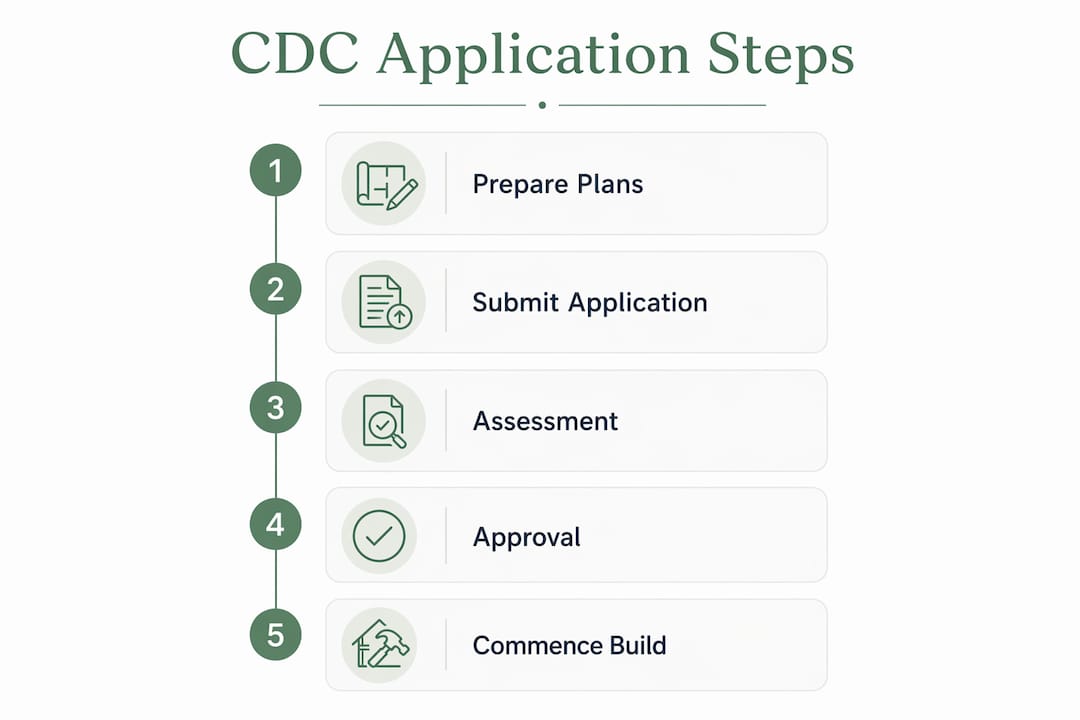
Applications go through the NSW Planning Portal, which is the mandatory lodgement platform for all CDC submissions. You can nominate either your local council or a registered private certifier as the assessing authority.
The process, step by step:
- Step 1 — Check eligibility: obtain a Section 10.7 planning certificate and confirm your project falls within Codes SEPP standards
- Step 2 — Engage a certifier early: discuss your project before finalizing plans; certifiers can flag compliance issues before you commit to a design
- Step 3 — Prepare documentation: site plan, floor plans, elevations, structural plans, building specifications, and any additional documents required by the certifier
- Step 4 — Lodge via NSW Planning Portal: create an account, select "Complying Development Certificate," and complete all application pages
- Step 5 — Pay fees: the portal charges a lodgement fee, and the certifier or council charges their own assessment fee separately
- Step 6 — Assessment period: the certifier reviews for 100% compliance with the Codes SEPP; no mediation or negotiation occurs
- Step 7 — Neighbour notification: two required notifications exist, one pre-approval and one pre-construction
- Step 8 — Certificate issued: once compliant, the CDC is issued with conditions; construction can proceed
Pro Tip: The Pre-DA Assist tool on the NSW Planning Portal overlays your architectural plans against Codes SEPP standards and generates a compliance report before you formally lodge. Including this report with your application gives the certifier a cleaner starting point.
What types of development qualify for a CDC in NSW?

The Codes SEPP covers a wider range of projects than most homeowners realize. The eligible development types span residential, commercial, and industrial categories.
Common residential examples:
- New one or two storey dwelling houses
- Alterations and additions to existing houses
- Granny flats and secondary dwellings
- Swimming pools
- Fences and retaining walls
- Ground-level decks, patios, and verandas
- Demolition of a building
- Home-based enterprises
- Dual occupancies, manor houses, and terraces (under the Low-Rise Housing Diversity Code, in R1, R2, R3, and RU5 zones only)
Exempt development is a separate, lower category: minor works like small garden sheds or interior renovations that require no approval at all if they meet the relevant low-impact standards. No CDC, no DA. Knowing which category your project falls into saves time and money from the start.
Size, height, setback, and site coverage limits all apply within the CDC pathway. Under the General Housing Code, for instance, lots must be at least 200 square meters with a minimum 6-meter frontage to qualify.
How are variations and changes to a CDC handled in NSW?
Historically, CDC required absolute compliance at submission. A single deviation from the Codes SEPP meant the project had to go through a full Development Application instead. The NSW Government has introduced a CDC variations pathway to address this rigidity.
What the variations pathway allows:
- Minor merit-based adjustments to specific development standards without triggering a full DA
- Assessment of small deviations in setbacks, height, or design elements
- Faster resolution for low-risk proposals that fall just outside strict CDC parameters
- Certifier-led assessment rather than full council merit review
The variations pathway has limits. Major departures from Codes SEPP standards still require a DA. If you are unsure whether your proposed change qualifies as a minor variation, your certifier is the right first call. They carry liability for the approval and will tell you plainly whether the variation pathway applies or whether you need to redesign.
What costs and timelines should you expect for a CDC in NSW?
Fees come from two sources: the NSW Planning Portal charges a lodgement fee of $47 per application, and the certifier or council charges their own assessment fee on top of that. Certifier fees typically range from $1,500 to over $5,000 depending on project complexity and the certifier you choose. Contact certifiers directly for quotes, as rates vary.
Practical expectations:
- Standard CDC: 20-day assessment period from lodgement
- Housing Pattern Book pathway: 10-day assessment, with neighbor notification required at least 7 days before approval
- Neighbor notification: two rounds required for standard CDC (pre-approval and pre-construction)
- Fees are non-refundable: if your application is rejected for non-compliance, you do not get the assessment fee back
- Inspections: the certifier will schedule mandatory inspections at key construction stages after the CDC is issued
- Homeowner savings: up to $15,000 when building a house under complying development, compared with the DA pathway
The 20-day clock does not start until your application is complete and accepted. An incomplete submission resets the timeline.
How does a CDC differ from a Development Application in NSW?
The core difference is how each pathway reaches a decision. A CDC is a compliance check: if your project meets every standard, approval is certain. A DA is a merit assessment: council weighs up the proposal against planning objectives and can approve, refuse, or impose conditions at its discretion.
| Feature | CDC | DA |
|---|---|---|
| Assessment type | Checklist compliance | Merit-based judgment |
| Approval certainty | High, if fully compliant | Discretionary |
| Typical timeline | 20 days (10 for Pattern Book) | — |
| Public notification | Required (limited scope) | Full neighbor notification |
| Flexibility | Low, strict standards | Higher, council discretion |
| Refusal on merit | Not possible if compliant | Possible |
Use a CDC when your project fits neatly within Codes SEPP standards and you want speed and certainty. Use a DA when your project is complex, involves heritage, or needs design flexibility that the CDC pathway cannot accommodate.
How do you work effectively with accredited certifiers in NSW?
Accredited certifiers registered through the Building Professionals Board issue CDCs and carry legal liability for every approval they sign off on. That liability means they often request more documentation than the bare minimum the Codes SEPP specifies. Expect detailed checklists, additional engineering reports, and thorough site assessments.
How to get the most from the relationship:
- Engage early: talk to a certifier before finalizing plans, not after
- Check registration: verify your certifier is listed on the Building Certifiers Public Register via NSW Fair Trading
- Get a Section 10.7 certificate first: bring it to your first certifier meeting so constraints are already on the table
- Use a planning consultant for complex sites: a consultant familiar with local LEP controls can identify issues before they become costly rejections
- Prepare complete documentation: site plans, floor plans, elevations, structural plans, specifications, and any BASIX certificate if required
- Ask about the variations pathway: if your design is close but not fully compliant, ask whether a minor variation can resolve it before redesigning
Pro Tip: Certifiers are not there to help you fix a non-compliant application. Their job is to assess what you submit. A planning consultant or experienced draftsperson who knows the Codes SEPP is the right person to get your documentation right before lodgement.
Navilot helps homeowners get to that point. The platform walks you through a guided property questionnaire, identifies your likely approval pathway, and generates a custom project roadmap with a document checklist tailored to your project type. It does not replace your certifier, but it means you arrive at that first meeting organized, informed, and ready. You can start a free project check to see what applies to your property before committing to anything.
Key Takeaways
Complying development in NSW offers homeowners a fast, certain approval pathway for straightforward projects, provided every Codes SEPP standard is met at lodgement with no exceptions.
| Point | Details |
|---|---|
| Approval speed | CDC approvals take as little as 20 days, compared to a much longer timeframe for a DA. |
| Strict compliance required | Applications must meet 100% of Codes SEPP standards; any deviation triggers a DA unless the variations pathway applies. |
| Two assessment bodies | You can lodge with your local council or a registered private certifier, whichever suits your project. |
| Fees are non-refundable | Certifier fees of $1,500 to over $5,000 are not returned if your application is rejected. |
| Check eligibility first | A Section 10.7 planning certificate confirms whether CDC is possible on your specific land before you spend money on plans. |