
Yes, you need a Construction Certificate (CC) before any physical building work begins in NSW. The CC sits between your development consent and the first day on site, and starting without one is unlawful under NSW planning law. It can trigger stop-work orders and fines.
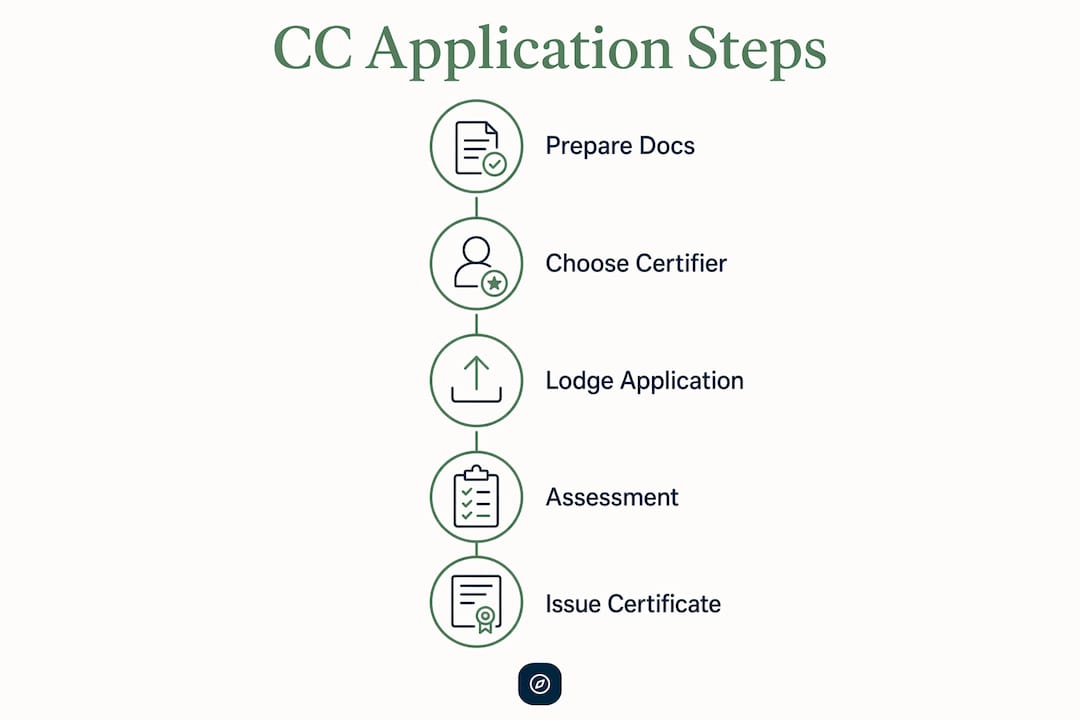
Your single next step: get your construction drawings to CC-level detail, then lodge your application through the NSW Planning Portal or engage a registered certifier directly.
Three official channels handle everything:
- Service NSW — the gateway for online lodgement and fee payment
- NSW Planning Portal — where CC applications are submitted and tracked
- NSW Department of Planning — the regulatory authority setting the rules and post-consent guidance
The CC confirms your construction plans and specifications comply with the Building Code of Australia (BCA) and every condition attached to your development consent. No CC, no lawful construction.
Table of Contents
- What a construction certificate actually is — and when you need one
- Who can issue your CC — and how to choose between council and a private certifier
- Documents you must supply for a CC application
- How to lodge a CC application in NSW, step by step
- Typical timeframes and costs for a CC in NSW
- What happens after your CC is issued
- Common delays and how to avoid them
- Key Takeaways
- The part of the CC process most guides skip over
- How Navilot helps you get CC-ready without the guesswork
- Official sources and where to apply
What a construction certificate actually is — and when you need one
A Construction Certificate is not a second development application. Your DA (Development Application) approved what you can build. The CC confirms how you'll build it, specifically that your detailed construction drawings, materials, and engineering comply with the BCA and the conditions of your consent.
Timing matters. The CC must be obtained after development consent and before any physical building work starts. "Building work" covers everything from slab pours to framing, alterations, and additions.
Three categories don't require a CC:
- Exempt development — minor works that meet pre-set standards and need no approval at all
- Complying Development — fast-track approvals handled under a Complying Development Certificate (CDC), which bundles planning and construction approval into one
- Crown building work — certain government projects with separate approval pathways
The CDC comparison is worth understanding. A CDC is a single certificate that replaces both the DA and the CC for straightforward projects that meet specific development standards. If your project qualifies, a CDC is usually faster. If it doesn't, you go the DA route and then need a CC before breaking ground.
Starting work without a CC is not a technicality. Councils can issue stop-work orders, require demolition of unauthorized work, and pursue penalty infringement notices. The risk is real and the cost of getting it wrong far exceeds the cost of getting it right.
Who can issue your CC — and how to choose between council and a private certifier
Three types of authorized issuers can grant a Construction Certificate in NSW: your local council, a registered individual certifier, or a registered corporate certifier body. The choice between council and a private certifier is one of the most consequential decisions in your pre-construction program.

| Dimension | Local council | Private/accredited certifier |
|---|---|---|
| Typical turnaround | 6 weeks (longer with referrals) | 2–4 weeks for complete applications |
| Fee structure | Statutory scale tied to development cost | Negotiated; often higher upfront |
| Documentation standard | Thorough but may allow staged submissions | Expects near-complete documentation upfront |
| Scope of checks | Full BCA and DA conditions; may refer to heritage/fire agencies | BCA and DA conditions; same referral obligations |
| Council notification | N/A (council is the issuer) | Must forward CC to council within 2 days of determination |
When does a private certifier make sense? If you're running a time-sensitive renovation where holding costs on site are significant, paying for faster certification often reduces total project days more than it costs. Private certifiers are also well-suited to straightforward residential builds where the documentation is clean and complete.
Stick with council when your project involves heritage overlays, complex fire safety referrals, or any matter that requires a statutory agency referral. Council has the statutory relationships to manage those referrals in-house. A private certifier still has to make the same referrals, but the coordination adds friction.
Pro Tip: Before engaging any certifier, verify their registration on the NSW Fair Trading register and confirm their professional indemnity insurance covers your project class. An unregistered certifier cannot legally issue a CC.
Documents you must supply for a CC application
The gap between a DA set and a CC set is larger than most homeowners expect. CC plans must be significantly more detailed than what got your development consent approved — builders need slab setouts, wall and roof setouts, detailed material schedules, drainage and sewerage methods, and signed engineer calculations.
Core technical documents:
- Detailed construction drawings (floor plans, elevations, sections, block plan) drawn to scale
- Structural engineering details and signed calculations
- Materials and finishes schedule (walls, floors, roof, frame — with construction codes)
- Drainage, sewerage, and hydraulic specifications
- BASIX certificate (for residential projects subject to BASIX requirements)
- Geotechnical report if the site has slope, fill, or reactive soil conditions
- Fire safety schedule where required by the BCA
Administrative items:
- Copy of the development consent and any modification orders
- Owner details and contact information
- Builder details or owner-builder permit/declaration
- Estimated development cost (accurate — see the fee section below)
- Portal fee payment (a small fee per application, per the NSW Planning Portal fee schedule)
Special obligations for Class 2 buildings: If your project is a Class 2 residential building (apartments, multi-unit), the Design and Building Practitioners Act 2020 requires a set of declared regulated designs before construction starts. This significantly increases documentation obligations and requires registered design practitioners to sign off on each design element.
Pro Tip: The two documents that generate the most Requests for Further Information (RFIs) are structural engineering details and the BASIX compliance confirmation. Get your engineer to sign and date calculations before lodgement, and cross-check every BASIX commitment against your construction drawings. Mismatches between the BASIX certificate and the plans are the single most common cause of avoidable delays.
How to lodge a CC application in NSW, step by step
-
Confirm your development consent is in order. Read every condition on your DA. Some conditions must be satisfied before a CC can be issued — not after. Flag any that require a report, payment, or council sign-off.
-
Prepare CC-level construction documents. Commission your architect or draftsperson to upgrade DA drawings to full construction detail. Engage your structural engineer early — their calculations underpin the entire CC set.
-
Choose your certifier. Decide between council and a registered private certifier based on your timeline, project complexity, and documentation readiness (see the comparison above).
-
Lodge via the NSW Planning Portal. Applications are submitted online through the portal, either as a standalone CC or linked to your existing DA. Upload all documents using clear naming conventions (e.g., "CC-DrawingSet-Rev3-StructuralCalcs"). Large files should be compressed or split per portal guidance to avoid upload failures.
-
Pay the portal fee. The NSW Planning Portal charges a $46 portal fee (FY25/26) for CC lodgement, separate from any council or certifier assessment fees.
-
Appoint a Principal Certifying Authority (PCA). The PCA oversees construction compliance and conducts mandatory inspections. You must appoint a PCA and submit an Intention to Commence Work notice at least two days before starting any building work. The PCA can be the same person who issued your CC or a different registered certifier.
-
Pre-lodgement checklist before you hit submit:
- All DA conditions checked and pre-CC conditions satisfied
- Engineer calculations signed and dated
- BASIX certificate attached and cross-checked against drawings
- Builder's licence number and insurance details included
- Accurate development cost estimate prepared from a market cost guide
- Portal fee payment ready
Typical timeframes and costs for a CC in NSW
Processing time depends almost entirely on two things: who assesses it and how complete your documentation is.
| Factor | Private certifier | Local council |
|---|---|---|
| Typical turnaround | 2–4 weeks | 6 weeks |
| With referrals (heritage, fire) | Add 2–4 weeks | Add 4 weeks |
| Incomplete documentation | Application returned; clock resets | RFI issued; clock pauses |
What drives the cost:
- Council assessment fees — calculated on your declared development cost using a statutory scale. If council determines your cost estimate is more than 10% below standard industry estimates, they will adjust the figure and increase your fees accordingly.
- Private certifier fees — negotiated directly; typically higher than council fees for the same project but offset by faster turnaround.
- Consultant and specialist report costs — structural engineering, hydraulics, geotechnical, and fire safety reports all add to the pre-lodgement spend.
- Long service levy — payable on construction costs above the statutory threshold.
- Development contributions — Section 7.11 or 7.12 contributions may be triggered by your DA conditions and are payable before or at CC stage.
The most avoidable cost blow-out is an underestimated development cost. Councils use standard industry cost guides to verify your declared figure. Relying on an optimistic owner estimate risks automatic fee uplifts and processing delays.
What happens after your CC is issued
The CC is not the finish line. It's the starting gun for a structured inspection regime.
Your PCA will schedule mandatory critical stage inspections at key construction milestones. Common inspection points include:
- Footings and slab before concrete is poured
- Frame inspection before lining
- Wet area waterproofing before tiling
- Final inspection before occupation
Missing a critical stage inspection is serious. If the PCA cannot inspect a stage because work has already progressed past it, they may require you to expose the work or, in the worst case, demolish and rebuild. Book inspections in advance and never pour or cover work without sign-off.
The PCA's role during construction is ongoing. They review any variations, confirm compliance at each stage, and ultimately issue the Occupation Certificate (OC) when the building is complete and compliant. You cannot legally occupy a new building without an OC.
Variations and amendments: Minor changes that don't conflict with the DA can sometimes be handled within the CC. Anything that changes the approved use, footprint, or a DA condition requires a formal DA modification before the CC can be updated. When in doubt, ask your certifier before proceeding — unauthorized variations can void your CC and delay the OC.
Common delays and how to avoid them
The most consistent source of CC delays is the gap between DA drawings and construction-ready documentation. Translating DA plans into constructible CC plans can take several months on complex projects. Homeowners who budget two weeks for this phase routinely find themselves three months behind program before a single brick is laid.
The delays that hit hardest:
- Incomplete structural engineering at lodgement (most common RFI trigger)
- Underestimated development cost triggering council fee adjustments
- Missing DBP obligations for Class 2 buildings (regulated design declarations)
- Heritage or fire safety referrals that weren't anticipated at DA stage
Scheduling advice: Build your CC preparation phase into the program before your DA is determined, not after. Engage your structural engineer and hydraulic consultant while the DA is still being assessed. That way, when consent lands, your CC documents are weeks away, not months.
Private certifier fees as a schedule risk-management cost make the most sense when your on-site holding costs are significant. A builder standing by at $5,000 a week while council processes a 10-week assessment makes a $3,000 certifier premium look very cheap.
Pro Tip: Run a pre-lodgement check with your chosen certifier before formally submitting. Most registered certifiers will review your document set informally and flag gaps before the clock starts. This single step eliminates the majority of RFIs and can cut weeks off your assessment time.
Key Takeaways
A Construction Certificate is a legal requirement in NSW after development consent and before any building work starts — and getting the documentation right the first time is what separates a two-week assessment from a three-month delay.
| Point | Details |
|---|---|
| CC is legally required | You must hold a CC after development consent and before any physical building work begins in NSW. |
| Private certifiers are faster | Private certifiers typically assess in 2–4 weeks; local councils typically take 6–12 weeks depending on project complexity and referrals. |
| Documentation completeness is the key variable | Incomplete structural details and inaccurate cost estimates are the two most common causes of delays and fee uplifts. |
| Two-day notice before starting work | You must appoint a PCA and submit an Intention to Commence Work at least two days before commencing construction. |
| Navilot helps you prepare | Navilot's tailored roadmap and document workspace help Sydney homeowners organize CC-ready documents and avoid the most common preparation mistakes. |
The part of the CC process most guides skip over
There's a tendency in guides like this one to present the CC process as a linear checklist — get consent, prepare drawings, lodge, wait, build. Clean and logical. The reality for most homeowners is messier, and the messiness almost always lives in the same place: the gap between what the DA approved and what a builder actually needs to construct it.
DA drawings are persuasion documents. They show a council what you want to build in enough detail to assess planning merit. CC drawings are instruction documents. They tell a builder exactly how to build it, down to the slab setout, the wall tie spacing, and the drainage fall. These are fundamentally different documents, and the design work required to get from one to the other is real professional work that takes real time.
What Navilot sees consistently is homeowners who receive their DA consent and immediately start counting down to construction, without accounting for the weeks or months of detailed design work still ahead. The CC phase isn't a formality. It's where the project gets built on paper before it gets built on site. Treating it that way, and scheduling accordingly, is the single biggest thing a homeowner can do to protect their program and their budget.
How Navilot helps you get CC-ready without the guesswork
Getting from DA consent to a lodged CC application means coordinating architects, engineers, certifiers, and council conditions simultaneously. Most homeowners have never done it before. Navilot is built for exactly that gap.
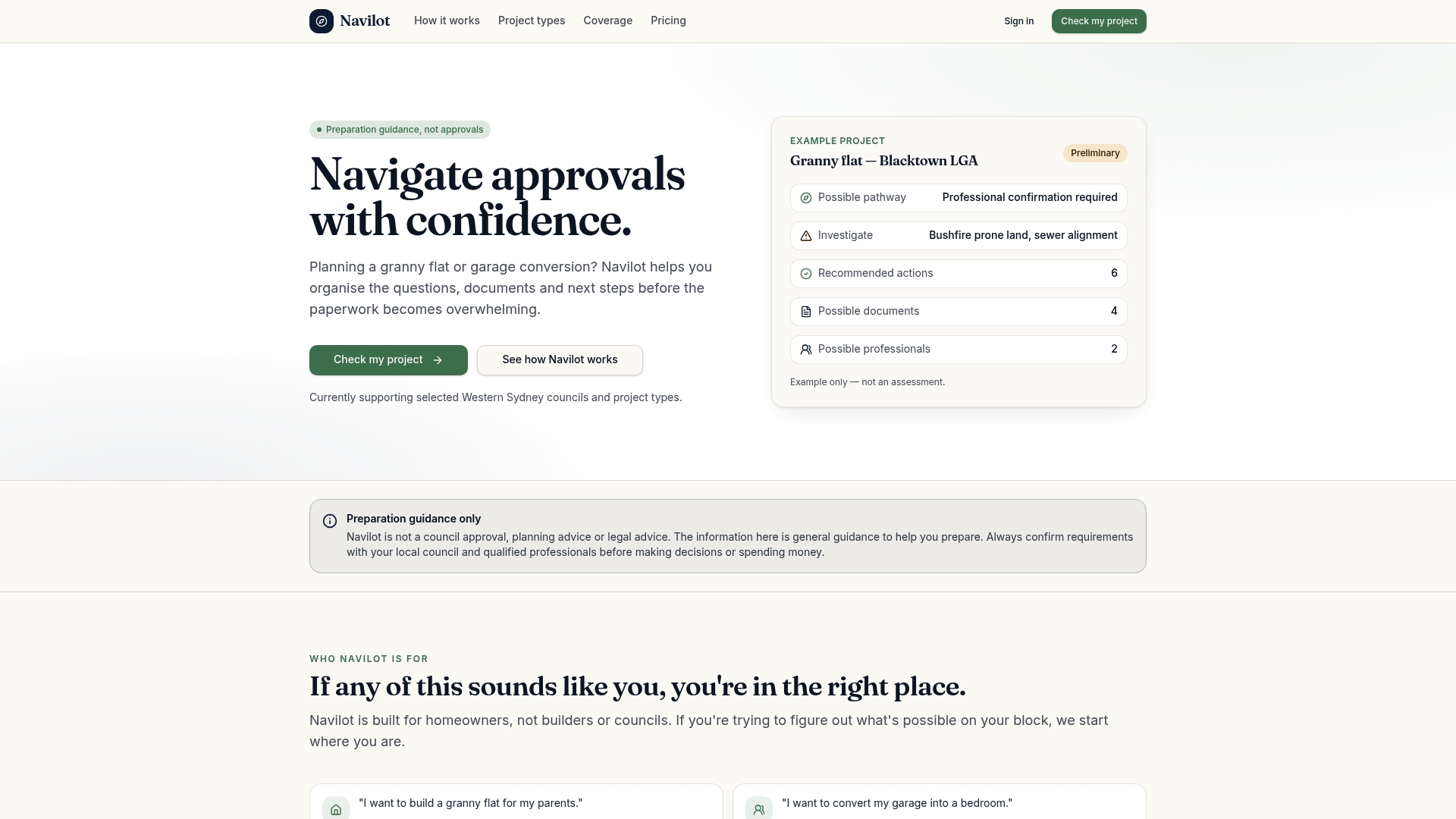
Navilot gives Sydney homeowners a tailored project roadmap that maps every document you need for the DA-to-CC transition, organized by your specific project type and council area. The document workspace keeps your drawings, engineer reports, BASIX certificates, and consent conditions in one place, so nothing gets missed at lodgement. The checklist flags which DA conditions must be satisfied before a CC can be issued, which specialist reports are typically required for your project class, and which certifier questions to ask before you commit.
Navilot does not act as a certifier and does not replace council approvals. What it does is make sure you arrive at lodgement prepared, with the right documents, in the right format, with no surprises.
Start with a free project check at navilot.net, or go straight to the pricing page to see how the detailed roadmap works. The paid roadmap is a one-time fee that covers your full preparation checklist and document toolkit for your project. Learn more about how Navilot works before you commit.
Official sources and where to apply
Use these government resources directly for lodgement, forms, and current regulatory guidance:
- Service NSW — Apply for a Construction Certificate: The official online lodgement gateway. Lists required documents, application steps, and fee payment for CC applications.
- NSW Planning Portal — Post-Consent Certificates: Where CC applications are submitted and tracked. Also lists authorized issuers and post-consent procedural requirements.
- NSW Department of Planning — Post-Consent Process Guide: The most detailed official guide to the CC process, including document requirements, PCA appointment, and inspection obligations.
- NSW Planning Portal — Service Fees: Current portal lodgement fees for CCs and other post-consent certificates.
For preparation support before you lodge, Navilot's coverage page confirms which Sydney councils and project types the platform currently supports.
This article provides general information about the NSW construction certificate process and is not legal or professional advice. Confirm current requirements with Service NSW, the NSW Planning Portal, or a registered certifier for your specific project.