
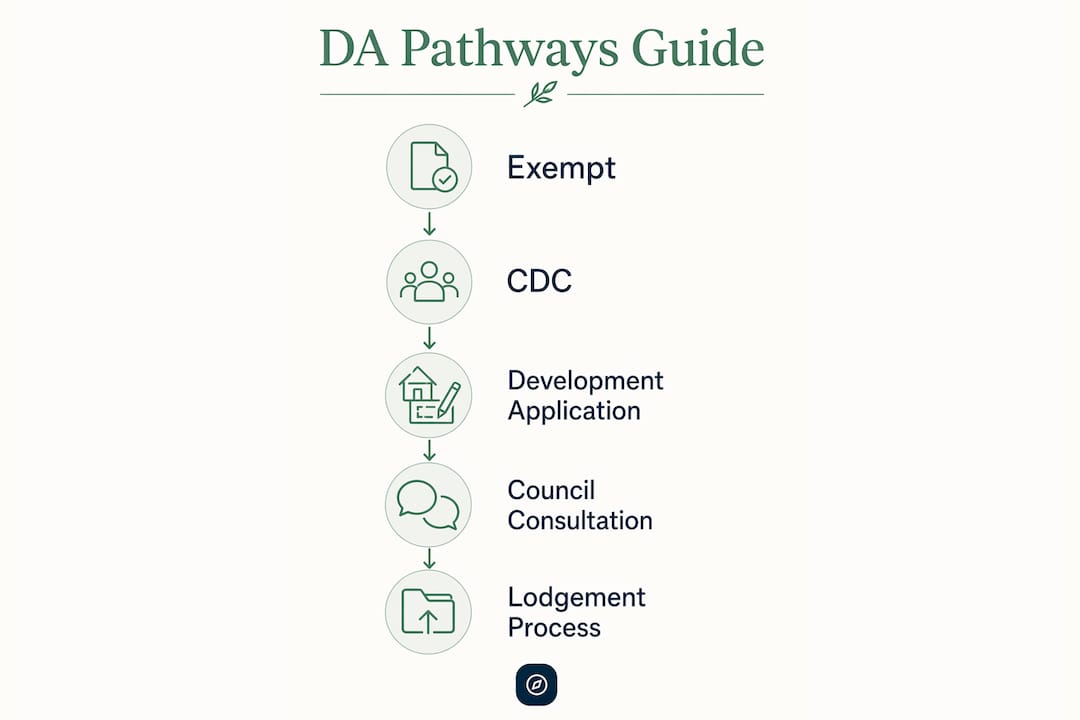
Most Sydney homeowners planning a renovation will need either a Development Application (DA), a Complying Development Certificate (CDC), or nothing at all — and the difference comes down to scale and impact. NSW has three primary approval pathways: exempt development (no approval needed), complying development (fast-track CDC), and development consent (a full DA). The NSW Department of Planning is clear that pathway choice depends on the potential impact of your work on neighbours — privacy, overshadowing, heritage, bushfire risk, and noise all factor in.
Three things to do right now:
- Check your property's zoning and overlays using the NSW Planning Portal Spatial Viewer — heritage, flood, and bushfire overlays change everything.
- Confirm whether your work meets Exempt or CDC standards, or whether a full DA is required.
- Book a council pre-lodgement meeting, or start Navilot's Free Project Check to map your pathway before spending a cent on consultants.
Table of Contents
- What does a development application in NSW actually require?
- What are the community notification rules for a DA?
- What can you do if your DA is refused or conditions are unacceptable?
- How do you read an LEP and DCP for your property?
- How much does a development application cost in NSW?
- Navilot helps you prepare before you spend on consultants
What does a development application in NSW actually require?
The three pathways: exempt, CDC, or DA
Exempt development covers minor works — small garden sheds, fences within height limits, some decks — where no approval is needed at all. A CDC is the faster alternative for routine projects like single-storey additions or granny flats that meet predetermined standards under the Codes SEPP or a local LEP; an accredited certifier can issue it without council involvement. A full DA is merit-based and applies when the work is higher-impact, sits in a sensitive zone, or simply doesn't fit the CDC criteria.
Homeowners often assume a DA is the only route. Checking CDC eligibility first can save weeks and significant cost.
How to decide your pathway: LEP, DCP, and the Spatial Viewer
Start with the NSW Planning Portal Spatial Viewer before commissioning a single report. It shows overlays — heritage conservation areas, flood-prone land, bushfire-prone land — that determine which specialist reports you'll need and which referral bodies must be consulted. Then open your council's Local Environmental Plan (LEP) and check the land use table for your zone. If consent is required, the Development Control Plan (DCP) sets the design standards your DA must meet: setbacks, height limits, landscaping ratios, and more.
Pre-lodgement: talk to council first
Pre-lodgement discussions with your local council are the single most effective way to avoid a rejected or incomplete application. Ask specifically about referral triggers — does your site require concurrence from Heritage NSW, the NSW EPA, or the Rural Fire Service? These are called integrated development situations, and they're the most common source of unexpected delays because council cannot finalise consent until every external body provides its terms.

Document checklist
The NSW Planning Portal application requirements set a mandatory baseline. Here's what to prepare:
Commonly required for most DAs:
- Completed online DA form (NSW Planning Portal account required — mandatory since July 2021)
- Statement of Environmental Effects (SEE) — see the SEE checklist for required content
- Site plan and survey
- Architectural drawings (floor plans, elevations, sections)
- Owner's consent (if applicant is not the owner)
- Cost estimate (use realistic contractor quotes — underestimating triggers fee recalculation)
- BASIX certificate (required for most residential building works in NSW — arrange early)
Required only when site controls trigger them:
- Heritage impact statement (heritage overlay)
- Bushfire assessment report (bushfire-prone land)
- Arborist report (significant trees on or near the site)
- Engineering or stormwater report (slope, drainage issues)
- Biodiversity assessment (threatened species or ecological communities)
For a complete DA lodgement checklist, cross-check your document set against council's own requirements before lodging.
Typical DA timeline
| Stage | Typical duration | Notes |
|---|---|---|
| Preparation and pre-lodgement | 4 weeks | Longer if specialist reports needed |
| Lodgement and completeness check | 1–2 weeks | Clock starts only when complete and fees paid |
| Public notification (if required) | 2–4 weeks | 14 or 28 days depending on development type |
| Referral periods (integrated development) | 4–8 weeks | Council waits for external body terms |
| Assessment officer allocation and review | 2–6 weeks | Officer sets a call-back date |
| Determination | Typical target times vary by council | Clock stops during any RFCI period |
The assessment clock stops the moment council issues a Request for Further Information (RFCI). Supply precise, scoped responses — not partial answers that trigger a second request.
How to lodge on the NSW Planning Portal
- Register for a NSW Planning Portal account via Service NSW.
- Start a new DA, enter the property address, and describe the development.
- Upload all required documents (plans, SEE, BASIX certificate, owner's consent).
- Enter the cost estimate accurately — this determines your lodgement fee.
- Pay council fees online to make the application complete.
- Track status in the Portal dashboard; respond promptly to any RFCI.
When your assessment officer introduces themselves and sets a call-back date, use it. Proactive contact reduces delays far more reliably than waiting for formal correspondence.
Pro Tip: Commission specialist reports in stages. Use the Spatial Viewer to confirm which overlays apply, then get conditional quotes from consultants — only order a heritage or bushfire report once you've confirmed the overlay is triggered. Bundling everything upfront wastes money on reports you may not need.
What are the community notification rules for a DA?
All DAs and plans are publicly available on the NSW Planning Portal from the moment of lodgement. For standard residential DAs, most councils notify adjoining neighbours by letter and display a site notice for 14 days. Advertised development — larger or higher-impact projects — requires a 28-day public exhibition period. Integrated development and projects affecting threatened species also trigger extended notification. During this period, any person may lodge a written submission with council, and the assessment officer must consider those submissions in the determination. You don't need to respond to submissions directly, but your consultant can address concerns raised in a supplementary letter if the issues are material.
What can you do if your DA is refused or conditions are unacceptable?
A refusal or an unreasonable condition isn't the end. NSW offers two main paths. First, you can apply to modify the consent under Section 4.55 of the Environmental Planning and Assessment Act 1979 — this is the right tool when conditions are overly restrictive or need minor adjustment. Second, if the DA is refused outright or conditions are unacceptable, you can appeal to the NSW Land and Environment Court within 6 months of the determination. The Court can hear the matter afresh (a merits appeal) and substitute its own decision. For smaller disputes, a council review of determination under Section 8.2 is faster and cheaper than Court proceedings — request it within 28 days of the decision notice.
How do you read an LEP and DCP for your property?
The LEP is the legal instrument. It tells you the zone, permitted land uses, and any site-specific provisions. Find your council's LEP on the NSW Legislation website or through the NSW Planning Portal, then locate the land use table for your zone and confirm that your proposed development is "permitted with consent." The DCP sits below the LEP and sets the detailed design controls — height, setbacks, floor space ratio, landscaping, and materials. DCPs are not legally binding in the same way as LEPs, but councils give them significant weight. When your design departs from a DCP standard, your SEE must explain why the variation is justified and how the development still meets the objectives of the control.
How much does a development application cost in NSW?
Council DA lodgement fees are calculated on the estimated cost of works and vary by council. As a rough guide, a residential renovation estimated at $200,000–$500,000 typically attracts council fees in the range of $1,000–$3,000 (estimates only — confirm with your specific council). Consultant costs add significantly more:
These are estimates and vary considerably by council, project complexity, and consultant. Sydney's inner-city councils — City of Sydney, Inner West, Waverley — tend toward the higher end for heritage-related reports. Always get itemized quotes and confirm which reports your specific site actually requires before committing.
Navilot helps you prepare before you spend on consultants
Before you book an architect or call council, knowing your likely pathway saves real money. Navilot is built for exactly this moment: a Sydney homeowner with a renovation idea who needs to know whether they're looking at a CDC, a DA, or something exempt — and what documents, council controls, and potential obstacles apply to their specific property.
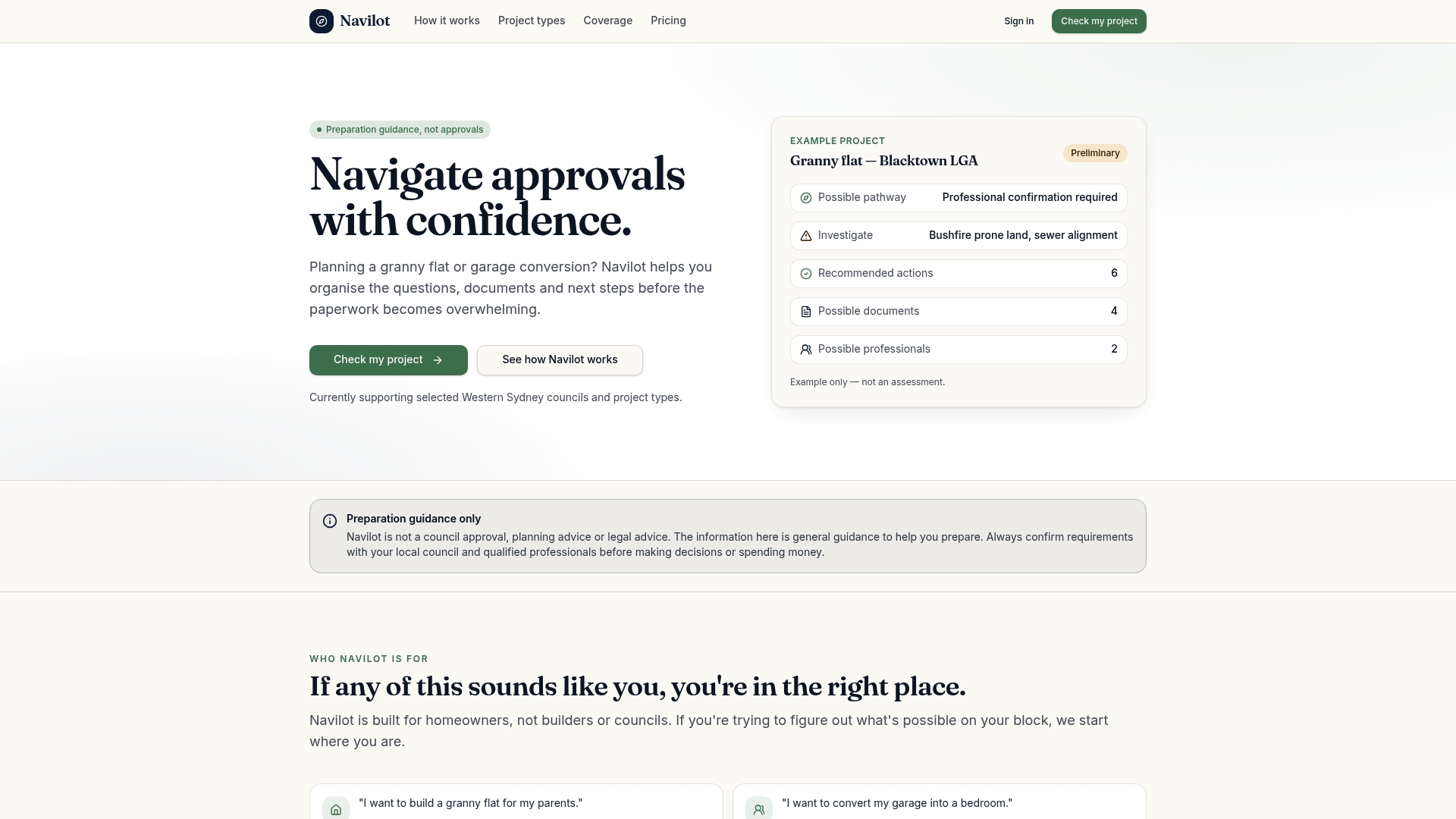
The Free Project Check takes a few minutes and gives you a clear read on your likely approval pathway. Upgrade to the $49 Detailed Roadmap and you get a custom checklist, a document preparation workspace, council-specific considerations, and a clear picture of what's ahead — all before you spend thousands on consultants who may take you down the wrong path. Navilot covers NSW councils across Sydney and supports the most common residential project types, including granny flats, garage conversions, and home additions. See how it works, or start your Free Project Check now.