
If the reasonable market cost of labour and materials for your residential building work exceeds $10,000 (including GST) and you are not engaging a licensed builder to supervise, you need an owner builder permit in NSW. Here are three things to do right now:
- Confirm development consent: You need an approved DA or Complying Development Certificate (CDC) in hand, not just an application number, before Service NSW can process your permit.
- Check your ownership interest: All owners of the land must be listed on the application. You cannot apply on someone else's behalf.
- Verify your White Card status: A current general construction induction card (White Card) is mandatory for every applicant. If your work is valued above $20,000, you also need to complete an approved owner builder education course before applying.
The Service NSW owner builder permit page is the hub for applying, checking, changing, and cancelling permits.
Table of Contents
- Who needs an owner builder permit in NSW?
- What training and cards do you need before applying?
- What documents do you need to gather?
- How do you apply for an owner builder permit in NSW?
- What does an owner builder permit cost and how long does it take?
- How do you check, change, or cancel a permit?
- What are your legal duties as an owner builder?
- What special circumstances cause delays or refusals?
- Key Takeaways
- Is being an owner builder the right call?
- How Navilot helps you prepare before you apply
- Authoritative sources and official links
Who needs an owner builder permit in NSW?
The threshold is straightforward: if the reasonable market cost of labour and materials for residential building work is over $10,000 including GST, and the work requires development consent, you need a permit. This applies when you are supervising or doing the work yourself rather than contracting a licensed builder to run the project.
Property types covered:
- A single dwelling house
- Dual occupancy (such as a semi-detached home) — subject to special circumstances
- A secondary dwelling (granny flat)
The work must involve constructing, altering, or adding to one of these property types. Commercial properties, investment properties you do not intend to live in, and work that does not require development consent fall outside the owner builder permit framework.
Applicant eligibility requirements:
- Aged 18 or over
- The owner, joint owner, or shareholder in the company that owns the land
- Alternatively, hold a minimum 3-year lease registered with NSW Land Registry Services
- Intend to live in the property after the building work is complete
- Hold a current White Card and, for work over $20,000, completed owner builder education
All owners of the land must appear on the application. NSW guidance is explicit: you cannot apply on another person's behalf, because the permit assigns full legal responsibility to the named permit holder.
The 5-year restriction: If you have held an owner builder permit for different land within the last five years, you are generally ineligible for a new permit unless you can demonstrate special circumstances. This rule exists to prevent serial use of owner builder status as a workaround for licensing requirements. The same-land restriction is less strict — if you previously held a permit for the same property, the application path is usually straightforward. Special circumstances must be clearly evidenced, typically through Form 7 and an in-person Service NSW appointment.
What training and cards do you need before applying?
White Card requirement
A current general construction induction card (White Card) or a SafeWork NSW Statement of Training issued within 60 days is mandatory for all applicants, regardless of project value. SafeWork NSW oversees general construction induction training in NSW. If you completed your White Card training recently but have not yet received the physical card, a Statement of Training from your registered training organisation (RTO) is acceptable, provided it is dated within 60 days.
Owner builder education for work over $20,000
For projects valued above $20,000, the Home Building Regulation 2014 requires applicants to complete five approved units of competency before a permit can be issued. These units cover construction planning, WHS, and contract management. Approved providers include RTOs listed on the NSW Government's owner builder course page, and the Owner Builder Centre (Australia) is one commonly referenced provider.
You may be exempt from the course if you hold:
- A general building work contractor licence
- A qualified supervisor certificate in general building work
- Certain other equivalent qualifications listed in the Home Building Regulation
If you hold one of these, bring your licence or certificate as evidence when you apply. Service NSW will assess whether it meets the education requirement.
Pro Tip: Save your White Card scan and education certificate as clearly named PDFs before you start the application, for example "WhiteCard_JohnSmith.pdf" and "OwnerBuilderCourse_Certificate.pdf." Service NSW's upload interface accepts PDF and JPG; named files reduce the chance of a staff member requesting resubmission due to an unidentifiable attachment.
What documents do you need to gather?
Getting your documents right before you start the online form saves the most time. Service NSW will not process an incomplete application, and the most common delays come from expired ownership evidence or the wrong type of development consent document.
Proof of ownership (one of the following):
- Council or water rates notice less than one year old
- Certificate of Title from NSW Land Registry Services
- Solicitor settlement letter showing settlement date, less than 3 months old and not future-dated
- ASIC company extract (for company-owned land)
- Copy of a minimum 3-year lease registered with NSW Land Registry Services
Development consent (mandatory):
- A copy of the approved Development Application (DA) from your local council, OR
- A Complying Development Certificate (CDC) from your council or an accredited certifier
This must be the approved document itself. An application number or a reference to a pending DA will not be accepted.
Identity and training documents:
- Proof of identity (government-issued photo ID)
- Current White Card or SafeWork Statement of Training (within 60 days)
- Owner builder education certificate or equivalent licence, if the project is over $20,000
Additional items where relevant:
- Signatures and consent from all joint owners
- Form 7 (Special Circumstances Additional Details) if the 5-year rule applies or the project is dual occupancy
- A copy of DBP (Design and Building Practitioners) registration if an existing secondary dwelling sits above a common space
Pro Tip: Photograph your rates notice and Certificate of Title in good lighting, then convert to PDF before uploading. Blurry or low-contrast images are a common reason Service NSW requests resubmission. Check the date on your rates notice before you start — if it is more than 11 months old, request a new one from your council first.
How do you apply for an owner builder permit in NSW?
Applying online through Service NSW
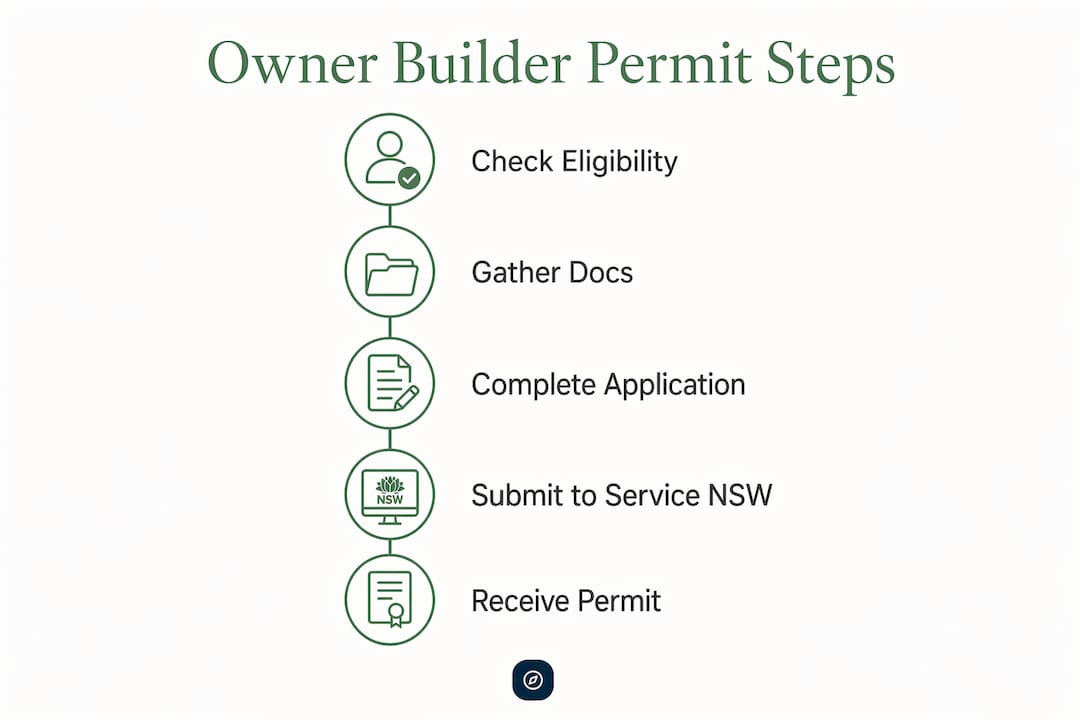
The online path is the fastest for straightforward applications. Here is the step-by-step process:
- Go to the Apply for an Owner-Builder Permit transaction page on Service NSW.
- Log in to your MyServiceNSW Account, or create one if you do not have one.
- Answer the eligibility checker questions. If you are ineligible, the system will tell you before you go further.
- Complete the application form fields: property address, estimated cost of work, details of all owners, and development consent details.
- Upload your required documents: proof of ownership, approved DA or CDC with plans, White Card, education certificate (if applicable), and any special circumstances form.
- Pay the application fee. Fees are listed on the Service NSW transaction page and may change, so confirm the current amount before you pay.
- Submit the application and record your reference number. Online applications are reviewed and can take up to 3 business days to process.
Applying in person
Download and complete the relevant form from the Service NSW website before your appointment:
- Form A: Individuals with freehold interest
- Form B: Individuals who are registered leaseholders
- Form C: Company-owned land
Book an appointment at a Service NSW centre. Bring originals and copies of all documents. If your application is complete and approved at the appointment, your permit may be issued the same day.
When in-person is required: Certain situations cannot be processed online. These include applications involving the 5-year restriction, dual occupancy projects, and cases where special circumstances need to be assessed in person. If you are unsure, call Service NSW on 13 77 88 before attempting the online form.

Pro Tip: The single most common reason for a delayed or rejected application is submitting a DA application number instead of the actual approved DA document. Bring the signed, stamped DA or CDC with its accompanying approved plans to your appointment. A photocopy of the approved document is acceptable; a reference number alone is not.
What does an owner builder permit cost and how long does it take?
Course and White Card fees
Owner builder education courses vary by provider. Fees generally range from a few hundred dollars upward depending on the RTO and whether you complete the course online or in person. White Card training through an RTO is typically available for under $100 at many providers, though prices differ. Always check the current fee on the provider's own website before booking, as prices change.
Service NSW application fee
Service NSW charges an application fee for owner builder permits. The fee is listed on the Service NSW transaction page and is subject to change. Check the current amount directly on that page before submitting your application.
Processing times
| Application type | Typical processing time |
|---|---|
| Online application | Up to 3 business days |
| In-person (complete application) | Potentially same day |
| Applications requiring special circumstances review | Longer — plan for additional time |
For work order tracking and contractor management during your build, using a structured system from the start keeps records clean for inspections and any future sale disclosure obligations.
How do you check, change, or cancel a permit?
Checking an existing permit
Service NSW maintains a public register of owner builder permits issued in the last 10 years. To check an owner builder permit:
- Go to the Check an Owner-Builder Permit transaction on Service NSW.
- Enter one of the following: licensee name, licence number, ABN, ACN, or location (suburb, postcode, or local government area).
- Select the search icon to view results.
This is useful both for verifying your own permit details and for buyers or tradespeople who want to confirm a property had an owner builder permit issued for recent work.
Changing permit details
If your contact details or project details change after your permit is issued, you can apply to change them through the Service NSW "Change the details on an Owner-Builder Permit" transaction. Supporting documents may be required depending on what is being changed.
Cancelling a permit
You can cancel an owner builder permit through Service NSW. Be aware that cancelling a permit does not reset the 5-year clock. If you cancel and later want to apply for a permit on different land, the original permit issue date still counts toward the restriction period. Think carefully before cancelling if you anticipate needing another permit within five years.
What are your legal duties as an owner builder?
Taking on an owner builder permit means taking on the same legal responsibilities as a licensed builder for that project. That is not a formality.
Your core obligations include:
- Complying with all work health and safety (WHS) duties on site, including inductions and safe work method statements for high-risk work
- Ensuring every tradesperson you engage holds the appropriate licence for specialist work (electrical, plumbing, gas fitting, and similar trades require licensed contractors in NSW)
- Managing contracts with subcontractors correctly and keeping records
- Meeting all conditions of your development consent and building approval
Insurance and liability:
Owner builders are not automatically covered by home warranty insurance the way a licensed builder's clients are. If you sell the property within 6 years of completing the work, you are generally required to obtain home warranty insurance (also called home building compensation) for the work done. Speak with a licensed insurance broker about your specific obligations, as the rules depend on the value and nature of the work. The owner builder responsibilities page on the NSW Government site covers this in detail.
Penalties for false applications:
Providing false or misleading information in an owner builder permit application is a criminal offense under the Crimes Act, carrying penalties including up to two years' imprisonment. This applies to misrepresenting ownership, project costs, or qualifications.
Pro Tip: Use written contracts with every tradesperson, even for small jobs. Document site inductions and keep copies of every subcontractor's licence. If something goes wrong on site, your paper trail is the difference between a manageable insurance claim and personal liability.
What special circumstances cause delays or refusals?
Most applications that hit a wall do so for predictable reasons. Knowing them in advance lets you fix the problem before it becomes a rejection.
Common situations requiring extra evidence:
- You held an owner builder permit for different land within the last 5 years
- The project involves dual occupancy
- You hold a leasehold interest and need to demonstrate freeholder permission
Red flags that trigger delays:
- Proof of ownership that has passed its currency threshold (rates notice over 12 months old, settlement letter over 3 months old)
- Submitting a DA application number instead of the approved DA document with plans
- Missing signatures from one or more joint owners
- An education certificate that does not match the approved units of competency
Here is a scenario that plays out regularly: a homeowner books a Service NSW appointment, brings a rates notice from 14 months ago, and assumes it will be fine. The officer cannot accept it. The appointment is wasted, and the homeowner has to request a new rates notice from council, wait for it to arrive, and rebook. The fix takes ten minutes if you check the date before you go. The delay costs two to three weeks.
Pro Tip: Before lodging your application, run through your documents with a council planning officer or contact Building Commission NSW if you have questions about eligibility. Navilot's free Project Check can also help you identify gaps in your document set and flag council-specific requirements before you hit the Service NSW form.
Key Takeaways
Getting an owner builder permit in NSW requires meeting the $10,000 threshold, holding a current White Card, supplying an approved DA or CDC (not an application number), and listing all landowners on the application.
| Point | Details |
|---|---|
| $10,000 threshold | A permit is required when labour and materials exceed $10,000 including GST and development consent applies. |
| White Card is mandatory | Every applicant needs a current White Card or a SafeWork Statement of Training dated within 60 days. |
| DA/CDC, not an application number | You must supply the approved DA or CDC document itself — a reference number will not be accepted. |
| 5-year restriction | A permit for different land within the last 5 years makes you ineligible unless you can show special circumstances. |
| Document currency matters | Rates notices must be under 1 year old; solicitor settlement letters must be under 3 months old. |
| Navilot preparation | Navilot's free Project Check and $49 Detailed Roadmap help you identify document gaps and council requirements before you apply. |
Is being an owner builder the right call?
The appeal is real. You control the budget directly, you are on site every day, and for the right project, the savings can be substantial. There is also something genuinely satisfying about knowing exactly what went into your own home.
But the legal exposure is often underestimated. As an owner builder, you are not just managing a renovation. You are taking on the full liability of a licensed builder for that project, including WHS obligations, subcontractor licence verification, and post-completion disclosure requirements when you sell. For a straightforward single-storey addition with a clear DA and experienced trades, that is manageable. For a dual occupancy project or anything involving complex structural work, the administrative and legal burden can outweigh the cost savings quickly.
The honest answer is this: if you are organised, have time to manage the project actively, and are working with reliable licensed trades, owner building can work well. If you are time-poor, the project is large, or you are relying on unlicensed labour to cut costs, a licensed builder is the lower-risk path. The permit is not the hard part. Managing the build legally and safely is.
If you do decide to proceed, the preparation stage matters more than most people expect. Getting your DA approved, your documents current, and your training sorted before you touch the Service NSW form removes most of the friction. That is exactly where a tool like Navilot adds value.
How Navilot helps you prepare before you apply
Sorting out your owner builder permit application is far less stressful when you know exactly what you need before you open the Service NSW form. Navilot is built for that preparation stage.
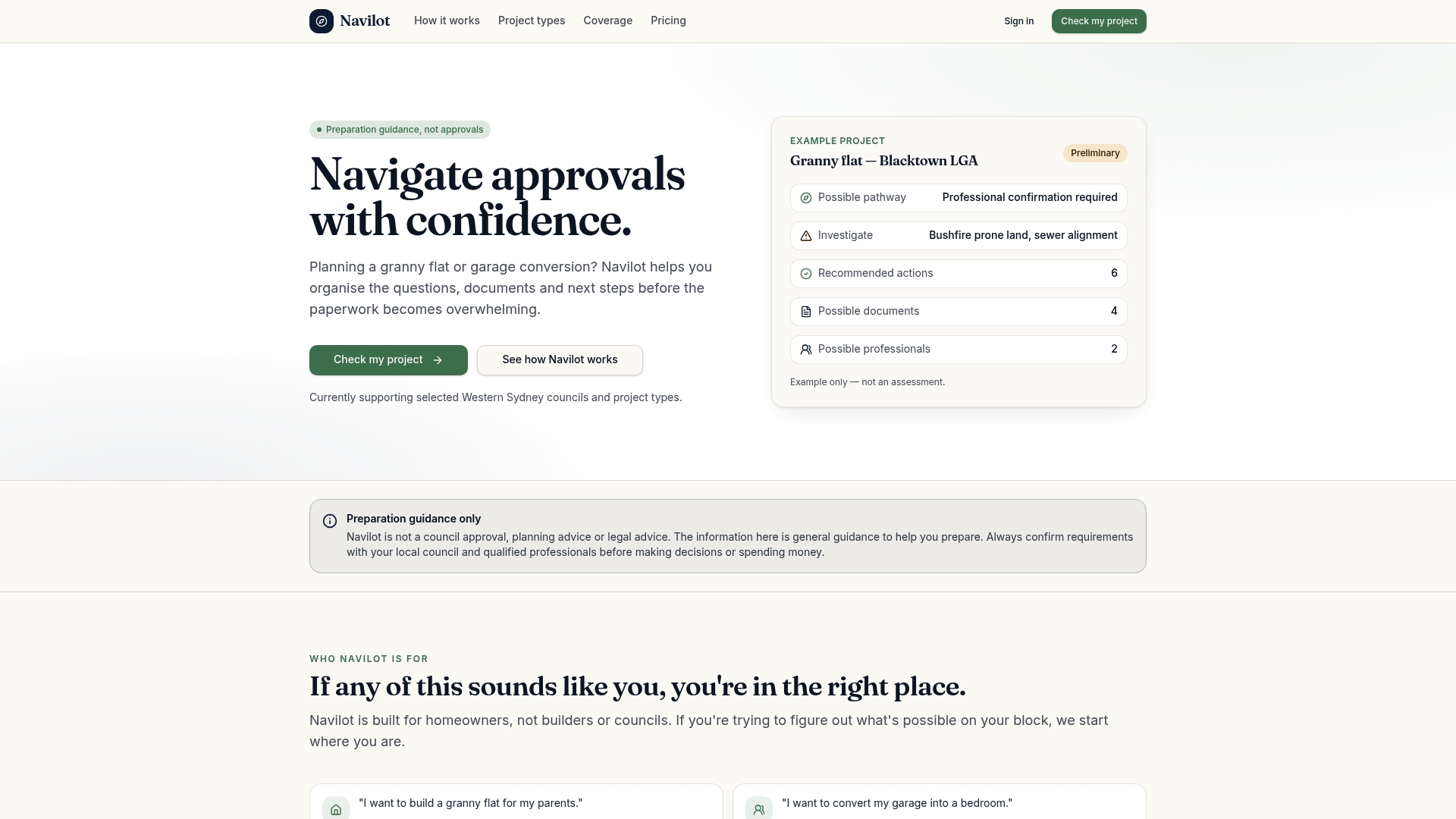
Start with a free Project Check: answer a short guided questionnaire about your property and proposed work, and Navilot maps out your likely approval pathway, flags the documents you will need, and identifies council-specific requirements for your area. For homeowners who want the full picture, the $49 Detailed Roadmap gives you a personalised, step-by-step document checklist and workspace to organise everything before you lodge.
Navilot does not replace your council approval or provide legal advice. What it does is get you organised so that when you sit down with Service NSW, you are not discovering missing documents halfway through the form. Check how Navilot works and see whether your project and council are covered, then start your free Project Check to get your preparation underway.
Authoritative sources and official links
Always verify current fees, processing times, and unit codes on official pages before applying. Requirements can change, and the official sources below reflect the current rules.
- Service NSW: Owner-Builder Permit — the transaction hub for applying, checking, changing, and cancelling permits
- Apply for an Owner-Builder Permit — the direct application transaction with the current document checklist and fee
- Check an Owner-Builder Permit — public register search for permits issued in the last 10 years
- NSW Government: When an owner-builder permit is needed — eligibility rules and threshold guidance
- NSW Government: Owner-builder responsibilities and rules — WHS, insurance, and legal obligations
- Home Building Regulation 2014 — the legislative basis for the $20,000 education requirement
- SafeWork NSW — for White Card (general construction induction training) requirements and registered training organisations
- Building Commission NSW — for questions about eligibility, compliance, and licensed contractor verification
- Owner Builder Centre (Australia) — one example of an approved owner builder education course provider; confirm current unit codes and fees on their website before enrolling