What the pool fence rules NSW require at a glance
Pool fencing requirements in NSW exist for one reason: drowning is a leading cause of accidental death in children under five in the state. The Swimming Pools Act 1992 makes it a legal obligation for every pool owner to maintain a child-resistant barrier around any pool holding more than 30cm of water — including portable and inflatable pools.
Here's what compliance actually means in practice:
- Fence height of at least 1.2m measured from the outside
- Boundary fences used as pool barriers must be at least 1.8m high
- Maximum gap of 100mm under the fence and between vertical rails
- A non-climbable zone (NCZ): a 900mm arc from the top of the fence, clear of any footholds or handholds
- Gates must self-close, self-latch, and open outward away from the pool
- Gates must never be propped open
- CPR signage displayed near the pool, readable from 3 meters
Drowning prevention starts at the fence line. Compliant barriers are the single most effective safeguard for young children around backyard pools in NSW.
Table of Contents
- Legal responsibilities and the standards your fence must meet
- Key takeaways on staying compliant with NSW pool fencing rules
- Exemptions and special cases under NSW pool fence legislation
- What to do if your pool fence doesn't meet the required standards
- How the rules differ for new versus existing pools in NSW
- Key Takeaways
Legal responsibilities and the standards your fence must meet
The NSW Office of Local Government places the compliance burden squarely on the property owner. You are responsible for the barrier's condition at all times, not just at inspection time.
Fence and gate standards
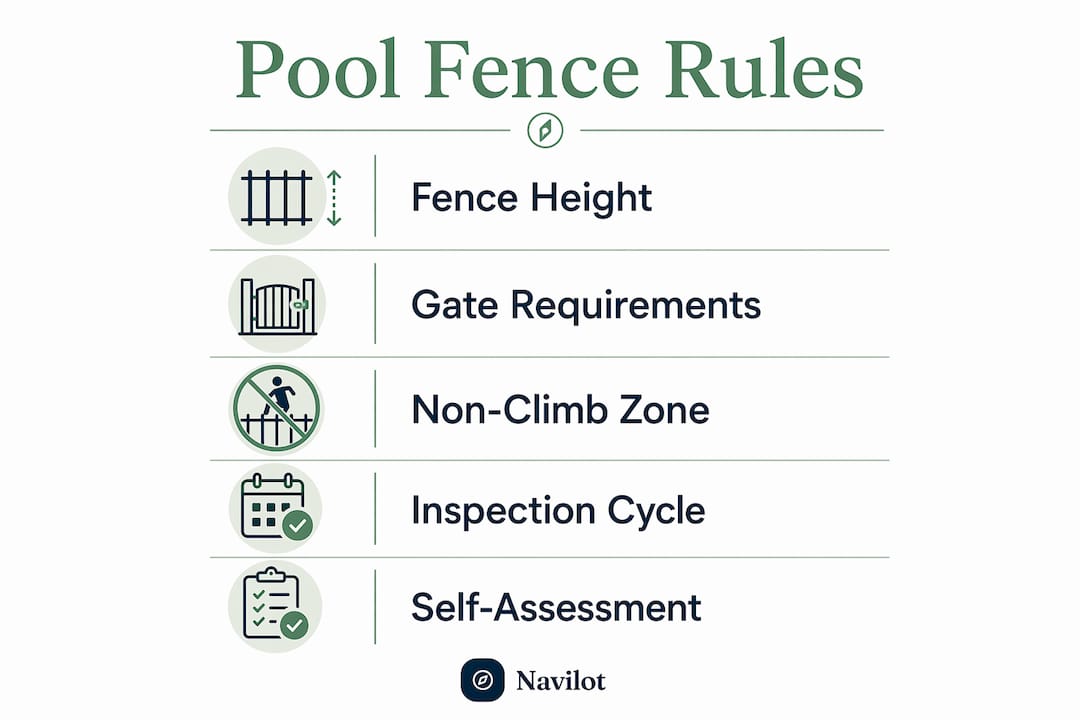
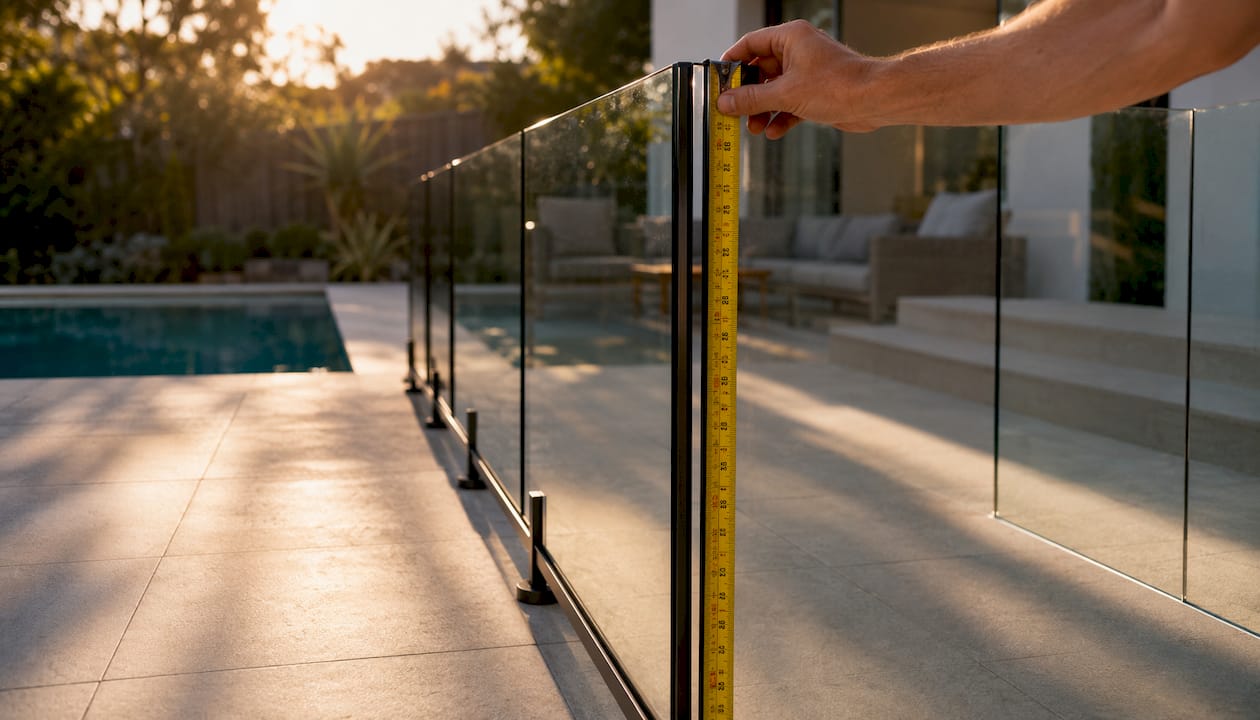
A standard pool fence must be at least 1.2m high, with gaps no wider than 100mm at the base or between vertical rails. If your boundary fence forms part of the pool barrier, it must reach at least 1.8m in height to comply, regardless of pool age. Mesh or perforated panels must have holes no larger than 13mm.
Gates are where most owners slip up. They must swing outward, self-close, and self-latch from any open position. The latch must sit 1,500mm above ground level on the outside, or 1,200mm if positioned inside the gate with at least 150mm clearance below the top.
The non-climbable zone
The NCZ is a three-dimensional arc, not just a flat perimeter. Objects like chairs, BBQs, plants, and toys must stay clear of the 900mm arc measured outward and downward from the top of the fence, plus 300mm inside the pool area. This is the most commonly failed compliance point.
Inspection and certification
Council inspections occur every three years on a risk basis, with a certificate of compliance or non-compliance issued after each visit. Private certifiers are also an option. The NSW Office of Local Government recommends checking gates and fences at least three times a year — at the start, middle, and end of swimming season.
Self-assessment before the inspector arrives
The NSW Swimming Pool Register provides tailored checklists based on your pool's construction date, since different Australian Standards under the AS1926 series apply depending on when the pool was built. Running through the relevant checklist before a formal inspection catches most issues before they become a compliance notice.
| Standard | Requirement |
|---|---|
| Fence height (standard) | Must meet prescribed minimum height from outside ground level |
| Fence height (boundary fence, post-2008) | Must meet higher prescribed minimum height |
| Gap under fence / between rails | Must not exceed allowed maximum gaps |
| Non-climbable zone | Clearance zone around fence top and inside pool area must be kept clear |
| Gate operation | Must self-close, self-latch, and open outward |
| CPR signage | Must be visible from an appropriate safety distance and comply with guidelines |
Owner responsibilities at a glance:
- Inspect gates and fences at least three times per year
- Keep the NCZ clear of all objects and vegetation
- Lubricate and test gate latches regularly
- Never prop a gate open
- Maintain pool compliance certificate records and register your pool
Key takeaways on staying compliant with NSW pool fencing rules
Compliance is continuous. A fence that passed inspection last year can fail today if a chair ends up against it or a gate latch corrodes.
- NCZ clearance is the top failure point: keep the 900mm arc around your fence permanently clear
- Gates need regular maintenance: lubricate latches, test self-closing function before each season
- Use the NSW Swimming Pool Register checklist matched to your pool's build date before any inspection
- CPR signage must stay current and visible from 3 meters at all times
- Portable pools are not exempt: any pool holding over 30cm of water falls under the same rules
Pro Tip: Run the NSW Swimming Pool Register self-assessment checklist at the start of each season — it takes 15 minutes and mirrors exactly what a council inspector checks.
Exemptions and special cases under NSW pool fence legislation
The Swimming Pools Act 1992 does allow local councils to grant exemptions, but only in narrow circumstances where strict compliance would be unreasonable given the specific property layout. An exemption is not a waiver of safety — councils typically require alternative measures, such as additional barriers or alarms, before granting one.
Spa pools follow a slightly different path. A spa must either be enclosed by a compliant pool fence and gate, or covered and secured by a lockable child-resistant structure such as a lid, grille, or mesh. Both options must meet the standards set out in the Swimming Pools Regulation 2018.
Indoor pools are also regulated. Access from a residential building must be restricted through compliant doorways and windows per the Building Code of Australia. The exemption pathway exists in legislation, but in practice councils grant them rarely and only with documented justification.
What to do if your pool fence doesn't meet the required standards
Start with the DA lodgement checklist to understand what documentation your council may require if structural changes are needed. Then:
- Identify the specific failure using the NSW Swimming Pool Register checklist for your pool's build date.
- Fix what you can immediately — remove NCZ obstructions, repair gate latches, replace broken rails.
- Engage a licensed pool fence contractor for structural issues like fence height or post replacement.
- Request a re-inspection from your council or a private certifier once repairs are complete.
A non-compliance certificate places a legal obligation on you to remedy defects within the timeframes specified. If you're selling or leasing, the certificate must be addressed before settlement or the tenancy begins. Fines for breaches under the Swimming Pools Act can be substantial, so acting quickly after any failed inspection is the practical move.
How the rules differ for new versus existing pools in NSW
The construction date of your pool determines which Australian Standard applies to your barrier. Pools built before September 1, 2008 may comply with earlier versions of AS1926, while pools built after that date — and especially after May 1, 2013 — must meet the more stringent requirements of AS 1926.1–2012.
The most significant practical difference involves boundary fences. A boundary fence that forms part of the pool barrier must be at least 1.8m high to comply in NSW, regardless of pool age. This distinction catches many owners off guard during inspections.
New pools also require swimming pool approval through council before construction begins, either as a Complying Development Certificate (CDC) or a Development Application (DA), depending on the project scope and your council's requirements. Navilot can help you identify which pathway applies to your property before you commit to a builder or lodge any paperwork.

If you're planning a new pool or renovating an existing one, Navilot's project preparation platform walks you through the approval pathway, compliance checklist, and document requirements specific to your Sydney council — before you spend a dollar on construction.
Key Takeaways
NSW pool fence compliance is a continuous legal obligation requiring correct barrier height, NCZ clearance, functional self-latching gates, and regular inspections at least three times per year.
| Fence height standards | Standard fences require 1,200mm; boundary fences used as pool barriers require 1,800mm. | NCZ is three-dimensional | A 900mm arc from the fence top must stay clear of all objects, inside and out. | | Gates are the top failure point | Self-close, self-latch, and outward-opening function must be tested every season. | | Pool age determines the standard | Build date sets which AS1926 version applies; use the matching Register checklist. | | Portable pools are included | Any pool holding over 30cm of water falls under the Swimming Pools Act 1992. |