Sydney Water Tap in® is the official online portal where property owners, builders, and developers in Sydney submit applications, track approvals, and manage water service projects from a single account. Available 24/7, the portal handles water connections, wastewater and stormwater connections, building plan approvals, service diagrams, and disconnection requests. If you're renovating, subdividing, or building new, Tap in is where your water compliance journey starts.
The portal exists to protect both your property and Sydney Water's underground infrastructure. Before any excavation, demolition, or new connection goes ahead, Sydney Water needs to confirm that pipes won't be damaged and that access for future maintenance stays intact. Tap in makes that process electronic, trackable, and faster than the old paper-based system.
- Submit applications for water, wastewater, and stormwater connections
- Request building plan approvals before excavating or building
- Order service and wastewater diagrams as PDFs
- Track application progress and review transaction history
- Apply for meter installation or disconnection of services
How to apply for water connections and disconnections via Sydney Water Tap in
Getting a connection or disconnection approved follows a clear sequence. The main friction point for most applicants is missing information at submission, which pushes applications into a manual review queue.
Step 1: Register for an account. Sign up at the Tap in portal using a valid email address. Once registered, you can log in at any time to access applications and transaction history.
Step 2: Identify your connection type. Applications cover water connections, wastewater connections, stormwater connections for single houses, and permission to discharge trade wastewater. Stormwater harvesting and sewer mining require a separate contact with Sydney Water directly.
Step 3: Gather your documents. You'll need site plans, property details, and any relevant engineering information before submitting. Incomplete applications stall.

Step 4: Submit and monitor. Simple connections receive approval quickly. Non-standard or large connections trigger a request for additional information before an approval letter is issued.
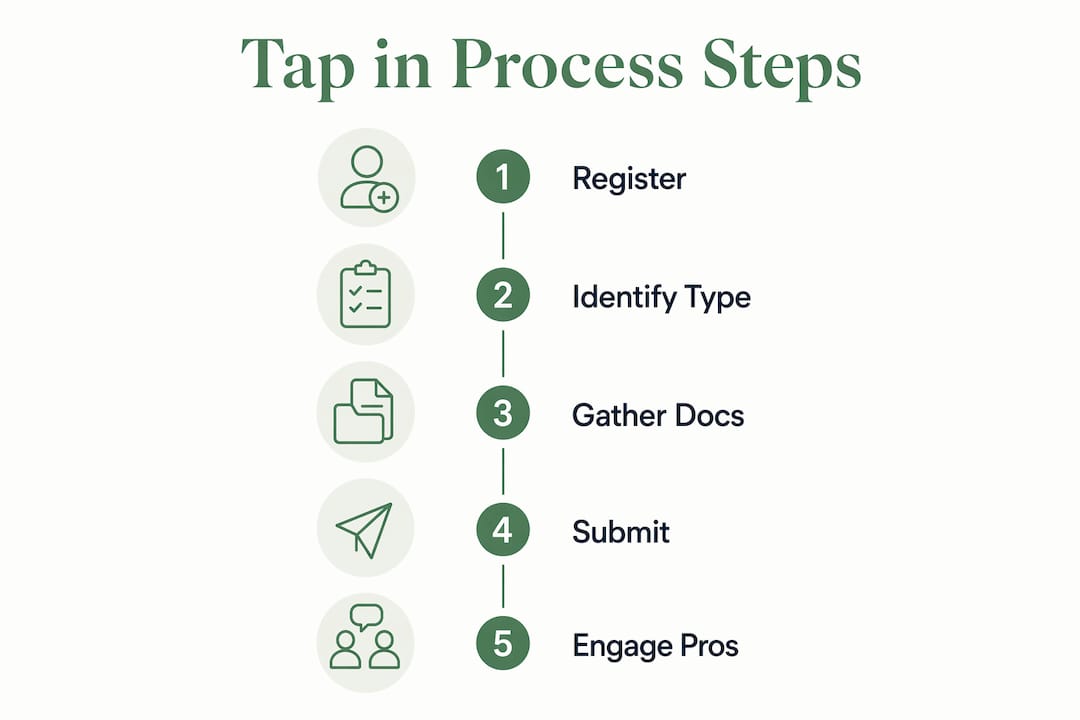
Step 5: Engage licensed providers. Once approved, listed drillers handle water main connections, listed constructors handle new wastewater connection points, and licensed plumbers join private plumbing to existing connections. Sydney Water must perform the connection itself when water mains exceed 200 mm, the connection exceeds 50 mm, or pipes predate 1930.
For disconnections, a licensed plumber must disconnect the service at the water main. This applies when a property is demolished, when lots are consolidated, or when unused services need to be removed to avoid ongoing charges and hidden leaks. Technical support is available by email at swtapin@sydneywater.com.au or by phone on 13 000 TAP IN (1300 082 746), Monday to Friday, 8:30 AM to 5:30 PM.
Building plan approvals through Sydney Water Tap in
Building plan approval is required before you excavate, demolish, or build on a property where Sydney Water pipes or structures are present. The purpose is straightforward: Sydney Water needs to confirm your proposed works won't damage its infrastructure or block future access for repairs.
Sydney Water automatically approves around 70% of building plan applications submitted through Tap in. The remaining 30% involve projects that build close to or over existing pipes, which get referred to a Water Servicing Coordinator for detailed assessment.
- Building plan approval is required even for swimming pools and home extensions
- Plans submitted via Tap in are reviewed against pipe locations on the property
- Automatic approval applies to straightforward plans with no pipe conflicts
- Complex or non-standard projects are referred to a Water Servicing Coordinator
- Section 73 Certificates are required for additional dwellings, townhouses, villas, and commercial or industrial developments
A Section 73 Certificate confirms that adequate water and wastewater infrastructure exists for a development. It must be obtained through a Water Servicing Coordinator or Sydney Water Developer Direct, not through the standard Tap in building plan approval process. Property owners and builders are responsible for the accuracy of submitted plans. Errors or omissions can result in delays, additional costs, or damage to infrastructure that the owner may be liable for.
Water meter installation and plumbing inspection requirements in Sydney
A water meter must be installed before you start using Sydney Water's supply. Failing to install one before use is treated as water theft, and fines may apply.
- A licensed plumber must install the water meter promptly after connection
- If you prefer Sydney Water to install the meter, apply via Tap in and they will do it free of charge
- Accredited backflow plumbers must assess the hazard rating for commercial and industrial properties
- A licensed plumber must install the correct backflow prevention device, which an accredited backflow plumber must then test every year
- Stormwater connections require licensed plumbers with confined space experience
- Fire service connections generally do not require a meter unless Sydney Water specifically requests one
Backflow prevention is the part of this process most owners underestimate. A backflow device stops contaminated water from flowing back into the public supply. For commercial properties, the annual testing requirement is ongoing, not a one-time obligation.
What does Sydney Water Tap in cost?
There is no single flat fee for Tap in services. Costs vary by service type, project scope, and whether a Water Servicing Coordinator is involved. Before submitting any application, check Sydney Water's "Other prices" page for current charges.
- Diagram and print purchases carry their own fees
- Building plan approvals, connection applications, and meter installations each have separate charges
- Water Servicing Coordinator involvement adds professional fees and extends timelines
- The applicant, not the plumber or consultant, is responsible for all costs
- Billing questions can be directed to swtapin@sydneywater.com.au or 1300 082 746
Pro Tip: Check the pricing page before you submit, not after. Some service types carry charges that applicants don't anticipate, and knowing the cost upfront helps you budget accurately and avoid surprises on your invoice.
Who is responsible for what: Sydney Water, NSW Fair Trading, and property owners
Three parties share responsibility across any water service project, and understanding the split prevents costly misunderstandings.
Sydney Water manages the infrastructure, reviews applications, issues approvals, and performs connections where required by its own rules (large mains, unusual pipe materials, pre-1930 pipes). It does not perform private plumbing work.
NSW Fair Trading oversees the licensing of plumbers and enforces compliance with the Plumbing Code of Australia. Any physical work on water or wastewater connections must be carried out by a licensed plumber. NSW Fair Trading is the body that issues and regulates those licenses.
Property owners hold ultimate responsibility for compliance and costs, even when a plumber or consultant submits the Tap in application on their behalf. If a plumber makes an error on your application, you remain liable for the consequences. Engaging professionals with direct Sydney Water experience reduces that risk considerably.
How clean is Sydney's tap water?
Sydney's tap water is safe to drink straight from the tap. Sydney Water runs a monitoring program that conducts about 70 different tests on each sample, covering taste, odor, color, microorganisms, and chemical content. Samples are collected from source to tap, including lakes, rivers, filtration plants, and homes.
NSW Health regulates both Sydney Water and WaterNSW under the Sydney Water Act 1994 and the WaterNSW Act 2014. The Independent Pricing and Regulatory Tribunal (IPART) audits both organizations annually against their operating licenses. Around 80% of Sydney's drinking water originates from Lake Burragorang at Warragamba Dam, with the Sydney Desalination Plant supplementing supply during droughts.
Sydney Water publishes a daily water quality report that shows filtration plant performance and chlorine levels at the tap. The chlorine limit under the Australian Drinking Water Guidelines is 5 milligrams per liter. Cloudy water is usually harmless air bubbles; a chlorine taste disappears after water sits in a jug for about an hour.
Practical advice for homeowners navigating Tap in approvals
Most delays in the Tap in process come down to preparation, not the portal itself. Submitting incomplete plans, engaging unlicensed tradespeople, or skipping the building plan approval step are the three most common causes of project setbacks.
Register your Tap in account before you need it. Waiting until a builder is on-site to start the application process adds unnecessary pressure. Check whether your project requires a Water Servicing Coordinator early, because that engagement adds time and cost that needs to be in your project schedule from the start.
Pro Tip: Log into your Tap in account regularly to track application status. Sydney Water may request additional information, and a slow response from your side can stall an otherwise straightforward approval.
Know your liability before you delegate. Even if your plumber handles the submission, the approval responsibility sits with you as the property owner. Navilot helps homeowners organize documents and map approval pathways before they reach the submission stage, so nothing critical gets missed.
Environmental and sustainability considerations in water connections
Sydney Water's infrastructure decisions carry environmental weight beyond the individual property. When you connect to or modify water services, you're interacting with a system that manages supply for millions of people across Sydney, the Blue Mountains, and the Illawarra.
Correct disconnection of unused services matters for sustainability as well as billing. Redundant connections left in place can develop hidden leaks that waste treated water and go undetected for months. Properly decommissioning services you no longer need is both a compliance requirement and a practical conservation measure.
Sydney Water monitors its pipe network for leaks and breaks to minimize waste between filtration plants and taps. The desalination plant at Kurnell provides drought resilience, but energy-intensive desalination is a last resort. Reducing demand through accurate metering, correct connections, and prompt leak reporting keeps the system operating on lower-impact sources for longer.
Key Takeaways
Sydney Water Tap in is the mandatory starting point for any water connection, disconnection, or building plan approval in Sydney, and property owners remain legally responsible for compliance regardless of who submits the application.
| Point | Details |
|---|---|
| Tap in is the required portal | All water connections, disconnections, and building plan approvals in Sydney must go through Sydney Water Tap in. |
| 70% of plans approved automatically | Sydney Water auto-approves around 70% of building plan applications; complex projects go to a Water Servicing Coordinator. |
| Meter must be installed within two days | A licensed plumber must fit the water meter within two days of connection, or Sydney Water will install it free via Tap in. |
| Owner liability is absolute | Property owners bear full responsibility for compliance and costs, even when a plumber or consultant submits on their behalf. |
| Fees vary by service type | There is no flat fee; check Sydney Water's "Other prices" page before submitting any application. |