
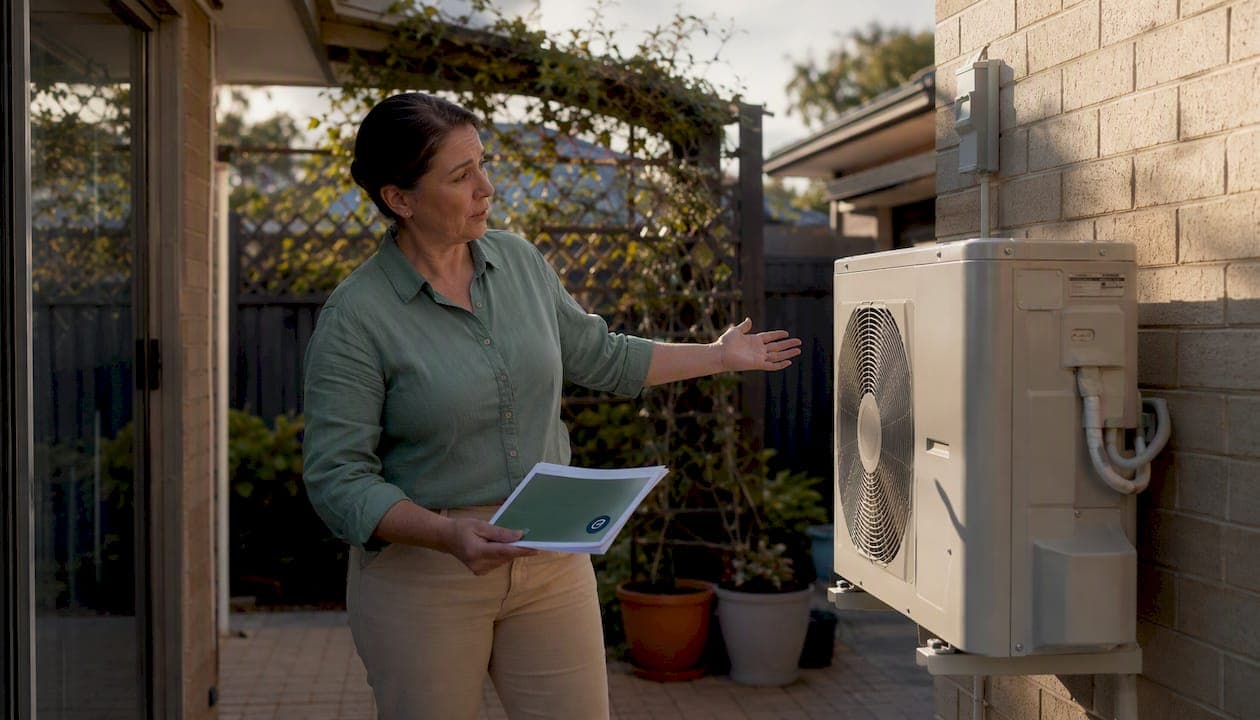
An air conditioner that can be heard inside a neighbor's bedroom or living room during restricted hours can breach NSW law — and repeated breaches after a warning can attract fines. The rule is simpler than most homeowners expect.
The short version:
- The operative test under Regulation 45 is audibility: if your unit can be heard inside a neighbor's habitable room during restricted hours, you may be committing an offense.
- Restricted hours are the windows when noise rules are strictest (weekday evenings, early mornings, and most of the weekend — see the table in the measuring section below).
- Immediate step: run a quick audibility check from your neighbor's boundary tonight. If you can hear the unit clearly, reduce fan speed or shift operation outside restricted hours until you confirm compliance.
Table of Contents
- How NSW air conditioner noise rules actually work
- How to tell whether your unit is too loud
- Common causes of noisy air conditioners you can check yourself
- Practical steps to reduce noise and meet NSW expectations
- How to pick a quieter, compliant air conditioner
- If a neighbor complains: the step-by-step response
- Navilot's pre-install checklist for air conditioner placement
- Key Takeaways
- Why planning before installation is the only move that makes sense
- Navilot helps you plan your installation the right way
- Authoritative sources and who to contact first
How NSW air conditioner noise rules actually work
The legal foundation is the Protection of the Environment Operations (Noise Control) Regulation 2017, made under the Protection of the Environment Operations Act 1997 (the POEO Act). Regulation 45 specifically covers domestic air conditioners on residential premises. It makes it an offense to operate a unit so that noise can be heard within a room in another residence during restricted hours. Penalties apply to individuals and corporations, and the framework uses a warning-then-repeat-breach structure: a first breach typically results in a warning or notice; a subsequent breach after that warning can attract a financial penalty.
Who enforces it:
- NSW EPA — sets the regulatory framework and publishes guidance, but does not typically handle individual residential complaints directly.
What counts as a habitable room is more specific than it sounds. Under the Regulation, habitable rooms are bedrooms and living areas. Garages, bathrooms, laundries, toilets, storage areas, and pantries are excluded. Critically, noise is considered "heard" even when windows and doors are closed — so the test is not whether a window happens to be open.
Restricted hours are the periods when the audibility rule applies most strictly. Outside those hours, a unit that can be heard may still be subject to action if the noise is "offensive" under the broader POEO Act — the law defines noise to include sound and vibration, and its intent is protecting comfort and repose at any hour.
Pro Tip: During extreme heat events, running your air conditioner outside normal hours may be a health necessity. Document the circumstances (temperature records, medical needs) if you operate during restricted hours in a genuine emergency — this context matters if a complaint is later investigated.
How to tell whether your unit is too loud
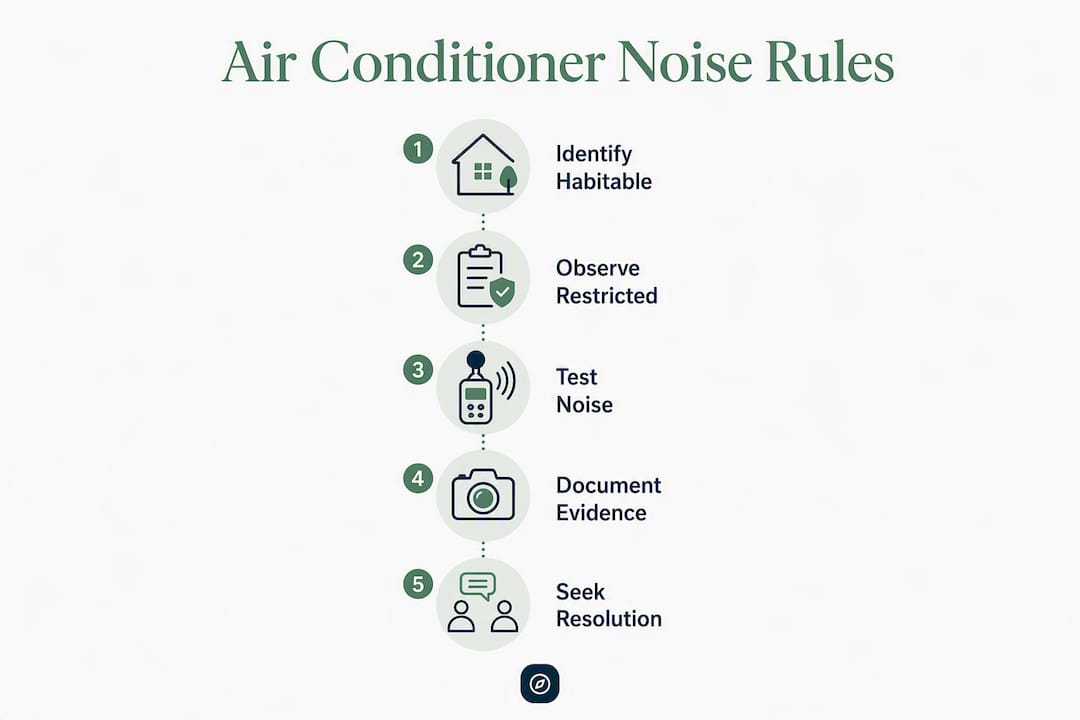
The practical test is straightforward: if you can hear the unit inside a neighbor's bedroom or living area during restricted hours, treat it as a potential breach and act before a complaint arrives.
Two quick homeowner tests:
- Boundary audibility test. Stand at your property boundary, closest to your neighbor's habitable rooms, while the unit runs at its normal operating level. If you can hear it clearly from there, it is almost certainly audible inside.
- Single-person room test. With a neighbor's cooperation, stand inside their bedroom or living room with the door closed. If the unit is audible, you have a real problem regardless of the hour.
When you run either test, record the time, your location, and what you hear. A short phone video with audio works well as a personal record, though it is not formal evidence.
Restricted hours quick reference:
| Day | Restricted hours |
|---|---|
| Monday to Friday | Before 9:00 AM and after 8:00 PM |
| Saturday | Before 9:00 AM and after 8:00 PM |
| Sunday and public holidays | Before 9:00 AM and after 8:00 PM |
Note: some councils publish slightly varied guidance. Check your local council's current schedule, as Blacktown Council's guidance illustrates the standard format used across NSW.
On smartphone decibel apps: they give a rough sense of volume, but calibrated acoustic meters and defined test procedures are what councils and courts accept as evidence. If a dispute looks likely, or if you are planning a new installation and want to confirm compliance before neighbors notice, hire an acoustic consultant. An acoustic report for a residential property in Sydney typically involves a site visit and a written assessment — costs vary, so request quotes from at least two consultants registered with the Australian Acoustical Society.
Pro Tip: Ask your installer for the unit's measured sound power level in dB(A) before commissioning. That number, combined with the proposed siting distance, lets a consultant or experienced installer estimate whether the unit will be audible at the neighbor's habitable room — before anyone complains.
Common causes of noisy air conditioners you can check yourself
Most air conditioner noise problems have a mechanical or installation cause that a homeowner can at least identify, even if a technician needs to fix it.
- Poor siting at installation. A unit placed directly outside a neighbor's bedroom window is the single most common cause of complaints. Distance and direction matter enormously.
- Inadequate anti-vibration isolation. Outdoor units mounted on hard surfaces without rubber pads or spring isolators transmit vibration through walls and floors, amplifying perceived noise inside both residences.
- Loose fan blades or worn bearings. A rattling or grinding sound that was not there at installation usually points to a mechanical fault developing over time.
- Blocked condenser coils or debris. Leaves, dust buildup, and restricted airflow force the fan to work harder and louder. This is one of the most common and most overlooked causes.
- Refrigerant issues. A hissing or bubbling sound often indicates a refrigerant leak or pressure imbalance — a licensed refrigeration technician needs to assess this.
- Aged or undersized compressor. Older compressors run louder as they wear, and an undersized unit running at maximum capacity is noisier than one operating comfortably within its range.
- Ductwork resonance. In ducted systems, poorly secured or undersized ducts amplify airflow noise and transmit it to rooms throughout the house.
When you call an installer or contact council, photograph the unit's base mounting, its distance from the nearest neighbor window, any visible rust or debris, and the gap between the unit and any existing screening. That documentation speeds up diagnosis and shows you are taking the issue seriously.
Quick maintenance checks any homeowner can do: clean or replace the filter, clear debris from around the condenser, and check that the unit sits level on its mounting. A unit that has shifted off-level vibrates more.
Practical steps to reduce noise and meet NSW expectations
Start with the cheapest interventions. They often solve the problem entirely.
- Reduce fan speed. Most split systems have a "quiet" or "sleep" mode that cuts noise output noticeably. Use it during evenings and early mornings.
- Reschedule operation. Shift heavy cooling or heating loads to midday when neighbors are less likely to be in habitable rooms with windows closed.
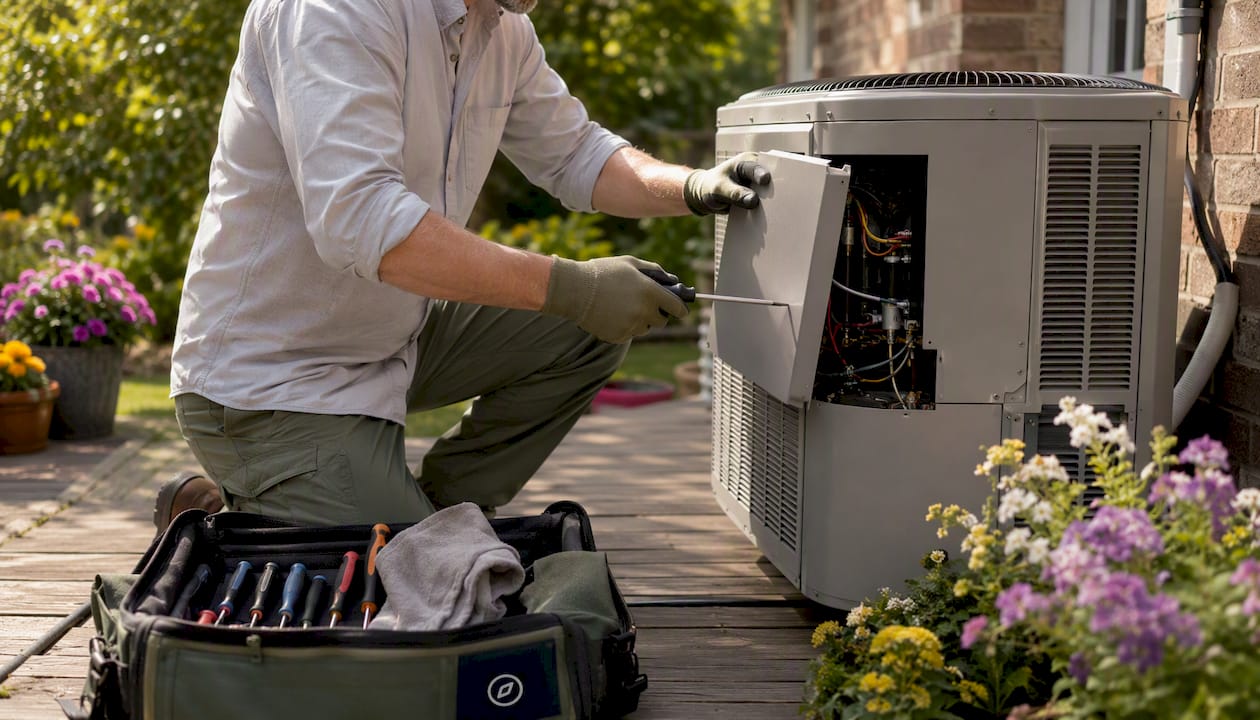
- Service the unit. A clean, well-maintained unit runs quieter. Book an annual service that includes coil cleaning, refrigerant check, and fan inspection.
If those steps are not enough, the next tier involves the installation itself.
- Re-site the outdoor unit. Moving it away from neighbor windows is the most reliable fix. Even a few meters of additional distance, or reorienting the unit so the fan exhaust faces away from the boundary, can make a measurable difference.
- Anti-vibration mounts. Rubber isolation pads or spring mounts under the outdoor unit cost relatively little and significantly reduce structure-borne noise transmission.
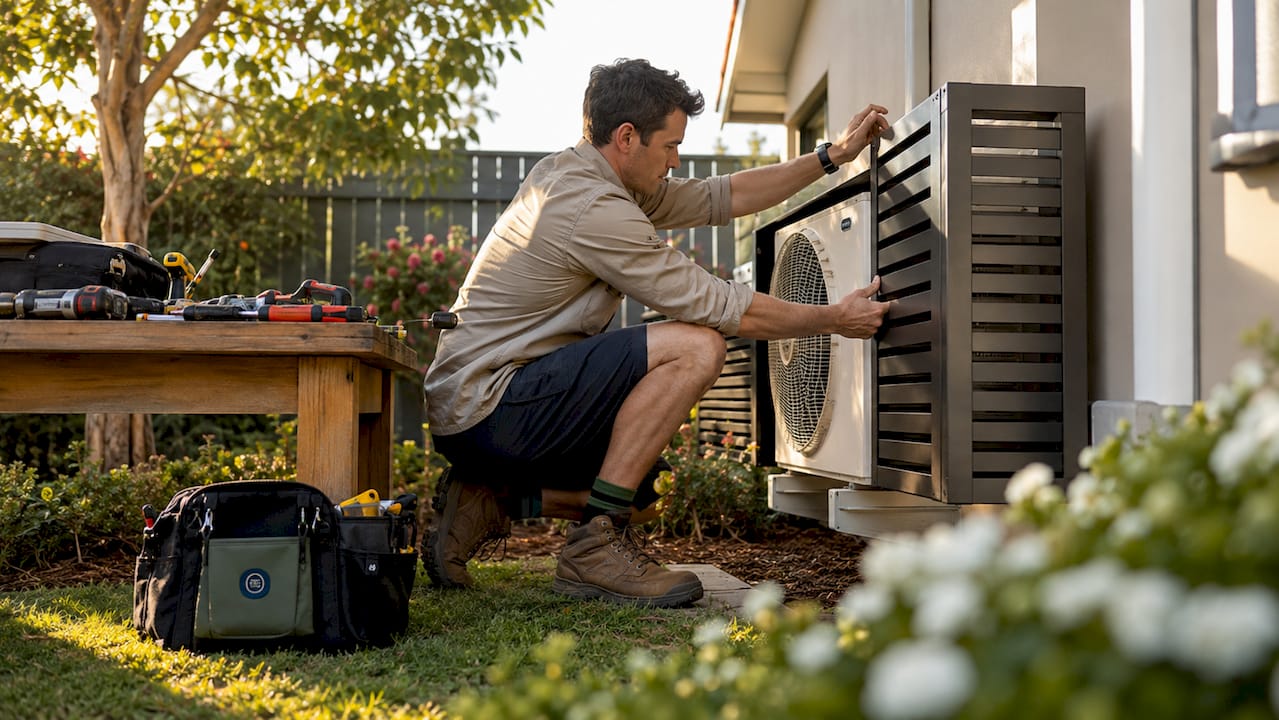
- Acoustic screening. Timber or metal louver screens placed around the outdoor unit can reduce noise at the boundary. The NSW EPA recommends acoustic shielding as a standard mitigation measure. Keep at least 300mm clearance on all sides to preserve airflow — a screen that chokes the condenser will increase noise and risk overheating.
For longer-term fixes, consider replacing the unit with a model carrying a lower certified sound power level (see the next section on noise labelling), or upgrading to a ducted system with attenuators on the supply and return ducts. These options cost more but eliminate the problem at the source.
Pro Tip: Never seal or heavily insulate around the outdoor condenser unit to reduce noise. Restricted airflow raises operating temperature, which increases compressor noise and shortens the unit's life. Screening works; sealing does not.
How to pick a quieter, compliant air conditioner
The NSW Noise Control Regulation requires new domestic air conditioners to carry an approved noise label stating the unit's sound power level. This label is one of the most underused tools available to homeowners at the point of purchase.
Before you buy or commission a unit, ask:
- What is the rated sound power level in dB(A) for both cooling and heating modes?
- What is the expected noise level at the nearest neighbor's habitable room given the proposed siting distance?
- Will the installer use anti-vibration mounts as standard?
- Can the installer test audibility at the neighbor's boundary after commissioning and provide a written record?
When to buy quieter vs. when to invest in siting or screening:
If the current unit is less than five years old and mechanically sound, acoustic screening and re-siting will usually deliver better value than replacement. If the unit is aging, running louder than it did at installation, or was never well-sited to begin with, a replacement with a lower sound power rating combined with correct siting is the cleaner long-term solution.
If a neighbor complains: the step-by-step response
The NSW EPA's guidance is clear: try to resolve the issue directly first. Most disputes that reach council could have been settled with a conversation and a service call.
- Acknowledge the complaint promptly. A quick, non-defensive response ("I'll check it tonight") prevents escalation more reliably than any other single action.
- Run the audibility tests described above and note what you find, including the time and conditions.
- Book a service inspection within a few days. Ask the technician to check mounting, fan condition, and refrigerant — and to provide a written service report.
- Document everything. Keep a simple log: date, time, what you did, who you spoke to, and any photos or service invoices. This record is your protection if the matter goes further.
- Follow up with the neighbor. Share what you found and what you have done. Most people respond well to visible effort.
If the issue is not resolved through direct negotiation, the neighbor can contact their local council. Council officers typically investigate, issue a warning or remedial direction, and give you an opportunity to fix the problem. Fines and formal noise abatement orders are generally reserved for repeat breaches after warnings have been ignored. NSW Police can issue immediate abatement directions for recurring late-night issues, particularly when council is not available.
Pro Tip: Keep copies of every service invoice and every written communication with your neighbor. If council does investigate, a clear paper trail showing good-faith action almost always results in a remedial direction rather than a penalty.
The NSW EPA's Noise Guide for Local Government notes that council officers prefer negotiated outcomes — relocating the unit, acoustic screening, or upgrading to a quieter model — over immediate enforcement, because air conditioner noise is typically an ongoing rather than one-off problem.
Navilot's pre-install checklist for air conditioner placement
Do these checks before purchase or installation. Relocating a unit after a complaint costs far more than siting it correctly the first time.
- Map neighbor habitable room locations. Walk your boundary and identify which neighbor windows are bedrooms or living areas. Note distances.
- Measure proposed siting distances. Record the distance from the proposed unit location to the nearest neighbor habitable room window.
- Request the sound power label. Ask the retailer or installer for the certified sound power level in dB(A) before committing to a model.
- Ask for a predicted noise level at the boundary. A competent installer can estimate the expected level at the neighbor's habitable room given the siting distance and any screening.
- Confirm anti-vibration mounting is included. Get this in writing in the quote.
- Identify screening options. Check whether a louver screen or barrier is feasible and whether it requires any council approval as part of your project.
- Plan a commissioning audibility test. Ask the installer to conduct and document an audibility check at the neighbor's boundary after installation.
- Store all paperwork in a project folder. Keep the noise label, installer quote, commissioning test record, and any council correspondence in one place.
Pro Tip: Navilot's project folder workflow is built for exactly this kind of documentation. Store your noise labels, installer quotes, and commissioning checklists in one organized workspace so you have everything ready if a council inquiry ever arrives. Start your project roadmap at Navilot to keep your installation records organized from day one.
If your air conditioner installation forms part of a larger renovation, a development application or complying development certificate may be required. Check with your council early.
Key Takeaways
Under NSW law, the practical compliance test is simple: if your air conditioner can be heard inside a neighbor's habitable room during restricted hours, you may be breaching Regulation 45 of the Noise Control Regulation 2017.
| The legal test is audibility — noise heard inside a neighbor's bedroom or living area during restricted hours may trigger a breach under Reg 45. Restricted hours apply daily in early mornings and late evenings on weekdays, weekends, and public holidays. Reducing fan speed, servicing the unit, and re-siting or screening the outdoor unit can resolve most complaints before council involvement. NSW law requires new units to carry a certified sound power label — checking this before purchase helps reduce compliance risk. Tools like Navilot help organize noise labels, installer quotes, and commissioning records in preparation for any council inquiry.
Why planning before installation is the only move that makes sense
The most common air conditioner noise disputes in NSW share one feature: the unit was placed without anyone checking where the neighbor's bedroom window was. That is not a technical failure. It is a planning failure, and it is entirely avoidable.
What surprises most homeowners is how quickly a complaint can escalate once it is lodged. Council officers are generally reasonable, and most investigations end with a remedial direction rather than a fine. But even a remedial direction means relocating or screening a unit that was just installed — a cost that dwarfs what a 30-minute pre-installation check would have taken.
The other underestimated risk is the noise label. Homeowners routinely buy the cheapest or most energy-efficient unit without looking at its certified sound power level. Two units with identical cooling capacity can differ by several dB(A) in real-world operation, and that difference is the gap between compliance and a complaint.
Planning does not require an acoustic engineer for every installation. It requires knowing where the neighbor's habitable rooms are, asking the right questions of your installer, and keeping the paperwork. That is the whole job for most residential projects.
Navilot helps you plan your installation the right way
Sorting out air conditioner placement, noise compliance, and council documentation before installation is exactly the kind of preparation Navilot was built for. Instead of piecing together requirements from multiple council websites and installer quotes, you get a single organized workspace: a guided project questionnaire, a custom checklist covering siting, noise labelling, anti-vibration mounting, and commissioning tests, and a document folder where you store everything from the noise label to the installer's written commissioning record.
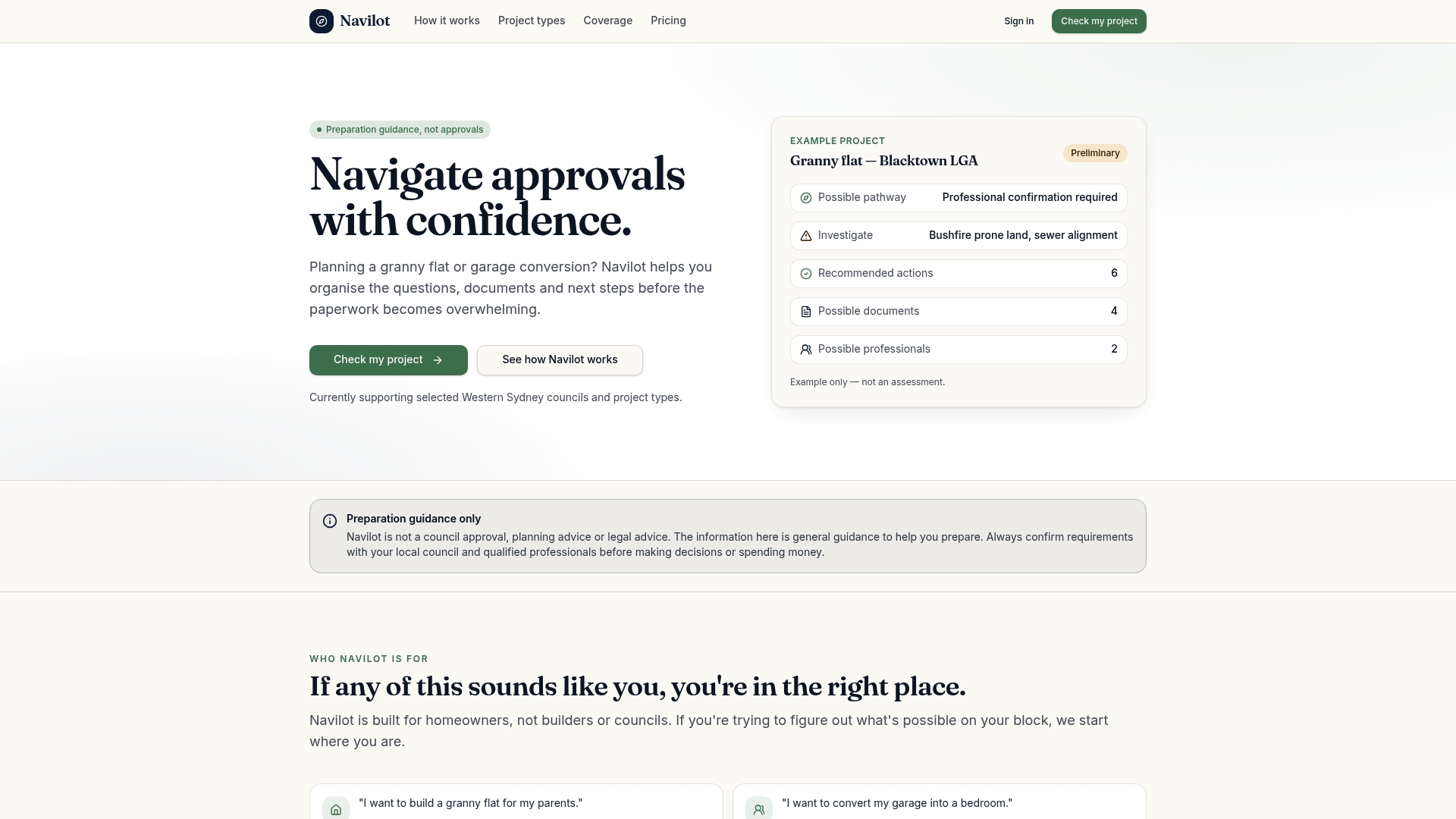
Navilot does not issue council approvals — that is the council's job. What it does is make sure you arrive at that conversation (or avoid it entirely) with every document in order and every compliance step already taken. For homeowners in Sydney planning a new installation or replacing an existing unit, start your project roadmap at Navilot and know exactly what you need before the installer arrives.
Authoritative sources and who to contact first
- Protection of the Environment Operations (Noise Control) Regulation 2017, Reg 45 — AustLII — the primary statutory source for the audibility test and penalty framework.
- NSW Legislation: Noise Control Regulation 2017 (full text) — includes noise labelling requirements for new domestic units.
- Protection of the Environment Operations Act 1997 — NSW Legislation — the parent Act defining offensive noise and enforcement powers.
- Regulating noise — NSW EPA — explains enforcement roles for councils, EPA, and police.
- Preventing neighbourhood noise — NSW EPA — practical siting, shielding, and quiet-model guidance.
- Noise Guide for Local Government — NSW EPA (PDF) — the detailed guide council officers use when investigating complaints.
Who to contact first:
Collect your evidence, service invoices, and any written communication before contacting council. Officers move faster when the paperwork is already organized.
This article provides general information about NSW noise regulations and is not legal advice. Confirm current rules and your specific circumstances with your local council, the NSW EPA, or a qualified legal professional.